Sign up for my newsletter to receive news and updates!

Archive for the ‘Uncategorized’ Category

Soundtracks on Spotify!

Last weekend @hannah_scarbs asked on Twitter whether I had the soundtracks to my novels on Spotify. To which the answer was no — but now it’s yes, because that made me realize that putting them up there is an eminently sensible idea. Of course not everything is available on that service (in particular, all of the Battlestar Galactica scores are absent, and I’ve drawn heavily on those over the years), but the vast majority were there! So if you want to know what my soundtracks sound like, now you can give ’em a listen. And if you want to know what each track maps to, I’ve also linked to that information for each book.

Cats!

I had somehow missed the news that there’s going to be a film of the musical Cats this year. (Prefatory comment: if you’re one of the haters that doesn’t like it, please don’t come into my comments to say so. I imprinted on this thing around the age of six.)

I’m . . . wary, but cautiously optimistic? The cast looks excellent, even if I’m a little nonplussed by casting Idris Elba as Macavity. (The lyrics describe that character as “very tall and thin,” and while he’s got the height covered, in terms of build I’d envision someone more like Mahershala Ali.) But Gus the Theatre Cat will be played by Ian McKellan, which sounds perfect, and I love love love that they’ve cast Judi Dench as Old Deuteronomy. I agree with the reservation Alyc expressed to me, which is that many of the people cast are good singers but not necessarily good dancers, but a lot depends on how they’re going to stage things; it may be that the bulk of the dancing is done by a backup corps rather than the lead characters.

A lot also depends on what they’re doing story-wise. Some of the people who dislike Cats as a musical do so because they went in expecting a full story, and instead got a series of song-and-dance numbers connected by a tenuous thread of plot. Are they going to beef that up for the film? If so . . . how? There isn’t a lot to work with, and I’m leery of any attempt to invent new material wholesale to create a bigger story. It makes me think of all the crap that got added to The Hobbit so they could stretch a very short book out to three films — I don’t want the same thing to happen here.

And I’m also crossing my fingers that they’ll make a couple of revisions to the lyrics. I may love Cats, but T.S. Eliot’s poems used a couple of unfortunate words for the Chinese characters, and there’s no need to carry those over to the film. But they’re single words and easily swapped out without breaking the scansion, so I hope they make that fix. From a different direction, I’m also wondering if they’ll do anything with the line about how Old Deuteronomy has “buried nine wives” — are we at the point as a society where we’ll just shrug and say, sure, Dench-eronomy had wives? We’ll see.

Ultimately, I just hope it doesn’t suck.

Read an excerpt from TURNING DARKNESS INTO LIGHT!

The release of Turning Darkness Into Light feels like it’s forever away — by which I mean, August 20th — but Tor.com is tiding us over with an excerpt!

(Be warned that it does contain spoilers for the later Memoirs, particularly Within the Sanctuary of Wings. I did my best to minimize how much those appear in the first few scenes, but ultimately this is a story that takes place around the time Isabella is writing her memoirs, i.e. several decades after the events in question; it just wasn’t possible — or rather, plausible — to write in a fashion that completely bypasses the effects of what happened in the series.)

A new gallery!

My recent trip to Yosemite netted me enough good photos that I’ve broken all my shots of the park out of the California gallery and into one of their own. Before, there were two; now there are eighteen! I’ve also added three Yosemite photos to the flower gallery. (I . . . think the thing you see in two of them is a flower? It may be a fungus. I’m not exactly a forest ranger.)

As usual, if you’d like to purchase prints (on any medium: paper, wood, glass, acrylic, metal, and more) or license any of the images for use in book covers etc., drop me a line!

The return of THE GAME OF KINGS

It’s no secret that I love Dorothy Dunnett’s Lymond Chronicles: a historical fiction series set in mid-sixteenth century Europe, starting off with English and Scottish politics, but eventually ranging farther afield to locations like France, the Ottoman Empire, and Russia. I blogged my way through a re-read of the first book, The Game of Kings, some years ago, inviting people who had read the whole series to join in on the analysis and enjoyment; I’ve written two articles for Tor.com on her work, one a brief squee about a duel in that book, and one about what epic fantasy writers can learn from Dunnett. In Writing Fight Scenes I use the aforementioned duel as a case study in excellent craft. Dunnett, I often tell people, is the one writer who just makes me feel abjectly inferior about my own work: she’s just that good.

The problem is, finding her books has been easier said than done. The editions I have were published in the late ’90s, and they were getting increasingly difficult to acquire.

But sometimes it seems like you can’t throw a rock in publishing without hitting somebody who imprinted on this series hard. So recently I got an email from Anna Kaufman at Vintage Books, who is in charge of re-issuing the entire series in new editions, asking if I’d be interested in a copy of the first book, in exchange for helping spread the word that, hey, they’re coming out again with shiny new covers etc.

WOULD I EVER.

cover art for THE GAME OF KINGS by Dorothy Dunnett

So if you’ve ever heard these books recommended, or you read them years ago and don’t have copies but would like some, or you’ve owned them for long enough that pages are starting to fall out, I’m delighted to say that the entire series is out as of today. Six books of amazingly good historical fiction, with some of the most unforgettable characters and events and prose I’ve ever encountered. Dunnett’s writing is not always easy to get into — it takes a little while to get the hang of reading her work, since she has a habit of doing things like describing stuff around the key element in the scene and trusting that the penny will drop for the reader in due course — but it’s amazingly rewarding once you do. And I aspire to someday write both intrigue and interpersonal conflict as well as she does.

A last-minute change of plans

Up until a couple of days ago, I was not going to be at the Nebulas weekend down in Los Angeles. But then Alyc Helms told me that most of the panelists for their panel had backed out, leaving only Alyc and the moderator to carry the topic, and they wanted to know if I’d be interested in pinch-hitting. Here’s the topic:

The Gentle Art of Cursing

Cursing functions as punctuation in every language and culture. While some areas seem consistent, such as the use of excrement, others vary wildly. By taking a look at cursing, we can learn a lot about what a culture considers sacred or taboo. Extrapolating from that, one can use cursing as part of worldbuilding to create a well-rounded world.

Nah– We’re just f*cking with you. This is a bunch of linguists and folklorists sitting around cursing and pretending to be academic about it.

With a topic like that, how could I refuse?

So I’m going to be at the Nebulas! The panel will be at 5 p.m. Friday. If you’re attending, come hear us use bad language for intellectual purposes, or just say hi to me at some other point!

It all started with a Tumblr post . . .

A little over year ago, I linked to a Tumblr conversation my husband had brought to my attention, and noted that debates of that kind are probably a regular feature of Lady Trent’s world, where there are a) dragons and b) a religion based on Judaism. And I said something about wishing I was conversant enough with Judaism to write a short story that would riff on that general idea — maybe not candles on Shabbat, but the intersection of dragons + religion.

A little over a year later, and thanks to the help of Noah Beit-Aharon in particular, I sold “On the Impurity of Dragon-kind” to Uncanny Magazine.

It will be out later this year, probably in their August issue, so as to coincide with the release of Turning Darkness Into Light. And because I must always find new forms of nerdery to explore with this series, the story takes the form of Isabella’s son Jake delivering a dvar Torah as part of his (somewhat belated) bar mitzvah. Whether I wind up writing the other “dragons + Judaism” story idea I had while trying to work this one out, we will see . . .

A Trip Down Juvenilia Lane, Vol. Not-9

Once upon a time, I started reading through my old notebooks from high school, college, and graduate school, and blogging about what I found therein, preparatory to packaging these things up and sending them off to be archived with my papers at Cushing. I’ve finally picked that project back up again, so let’s take a trip in the Wayback Machine to 2002!

(more…)

Avengers: Endgame

Outside the cut, no spoilers: I very much liked it. The film did the thing I really needed it to, which was to treat the fallout from Infinity War as a real and meaningful thing, rather than a brief speedbump in the story. At the same time, it wasn’t unrelentingly grim; the script did a good job of working in both gallows humor and situational bits of the sort where the characters are funny without meaning to be, which is something I very much like. The solution to the problem is naturally made from comic book cheese, but of a fairly good kind, and it allowed for an interestingly varied set of scenes on the way to the climax. The middle part of the movie worked in a lot of callbacks to earlier films and characters therefrom, without feeling like they’d been crowbarred in. And as a conclusion to the original three-phase plan for the MCU, I think its payoff works.

And now, spoilers.

(more…)

New Worlds: Painting

I’m not sure why, but it turns out my last two posts about new Patreon essays going up failed to post as scheduled. My apologies for not noticing that! I’ll keep an eye on it this week and manually push it if I have to.

Anyway, this month we’re talking about art! Starting with a discussion of the lines along which we declare things to be Art vs. Not Art, then continuing on to sculpture and, as of this week, painting — less the specifics of style and technique, more the uses to which we put such things. Comment over there (including on the older posts)!

(Edit: yeah, something’s wrong with WP, as this post also missed going live as scheduled. I’ll look into fixing that.)

Smart people saying smart things (II)

This interview is fascinating to me because I know basically nothing about cinematography, except insofar as it’s related to photography. So I love it when somebody gets down into the nitty-gritty details about how decisions regarding lenses and focus contribute to inequality, e.g. the fact that women on average speak about 25% of the time in a film + cinematographic technique that puts only the speaker in a shot in focus = not only are the women on screen silent more often than not, but they’re probably blurry as well. Backlighting, specific camera angles — she compares it all to the practice of airbrushing magazine covers, only there isn’t the same degree of public awareness that this stuff is being used to erase women’s flaws and present a constantly-idealized image. Plus lots of interesting discussion on how the relationship between a director and a director of photography differs between movies and TV, male directors and the YA film genre, etc.

On the deep and poisonous stream of anti-Semitism that runs through far too much of white evangelical Christianity. Key quote:

And it doesn’t really matter which “theory” a conspiracist starts with — Moon-landing hoaxers, anti-vaxxers, flat-earthers, young-earthers, chemtrails, fluoridation, Planned Parenthood, Antichrist OWG, blue helmets, black helicopters, whatever — the belief that the Key to Everything is “the startling news that the media isn’t reporting!” always leads, ultimately, to anti-Semitism.

This got me reflecting on my own childhood. My elementary school had a large Jewish contingent; I’m not sure how many, but my mother estimates somewhere between a quarter and a third of my class. It got watered down as we fed into junior high and high school, joining other elementary school catchment areas, but overall, they were almost certainly the largest minority in my area. Large enough that Jewish kids didn’t stand out as unusual to me — at least, not until those two years where they were all going through their Bar and Bat Mitzvah celebrations and I learned that being Jewish meant you got a special birthday party. (I probably went to more parties in junior high than any other period of my life.)

But at the same time, we were also in the neighborhood of this church. (In opening that page, I note that a section which used to detail a sexual abuse scandal within the church’s leadership has been removed. A scandal which, for all I know, could have involved kids in my class or my brother’s — the timing was right.) I don’t know how much of that anti-Semitic ideology is present there, or was thirty years ago. But it makes me wonder how much, despite the large presence and general acceptance of Jewish families in our neighborhood, there were still incidents that happened out of my sight or flew over my head. I know the guy I went to prom with gave me the first Left Behind novel to read; I didn’t get more than about ten pages into it because the writing was so execrable, but later I learned that boy howdy are those books anti-Semitic. And there were enough Baptist and evangelical Christians around that I have to imagine some of that was an issue in my community.

Short of randomly calling up my Jewish friends from sixth grade and asking them whether they got shit from our fellow students, I’ll never know. But it’s a sobering thing to consider.

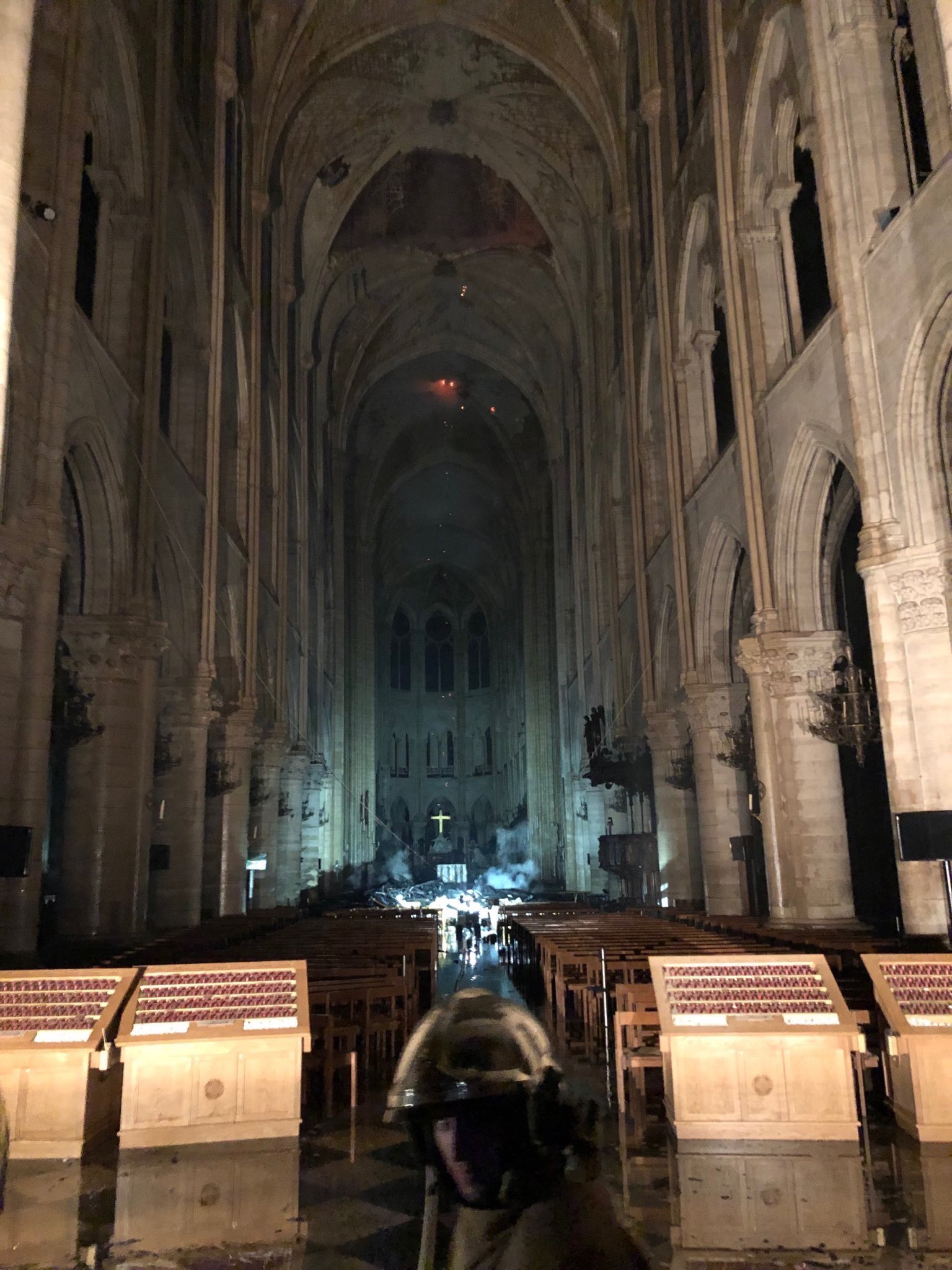
By comparison, this is a relief

All day I’ve been imagining the worst for Notre Dame: a gutted shell, structural collapse, destruction that would take decades to repair.

It isn’t as bad as I feared.

It’s still bad. I saw an aerial photo that showed the entire roof of the cathedral glowing in the night like a cross-shaped pit to hell, which primed me to expect the worst. But things that are good:

There have been no fatalities.

The statues on the spire were removed four days ago because of the renovations.

The clergy, military, and Louvre staff were prompt and organized in evacuating other precious items from the cathedral.

The towers were saved.

This tweet shows the interior; if you look at the photo full size, you can see a fair bit of detail. There’s water on the floor, but only one small portion of the ceiling collapsed, and the stonework throughout much of the nave looks basically untouched to me — not scorched or covered in soot, not damaged, not destroyed.

The superstructure is badly hit, I’m sure, and it’s likely that has caused or will cause problems which aren’t immediately visible. Repairs will still take a long time, and who knows how many days will pass before they can allow visitors again. But after a day of imagining things so much worse than this, it’s a relief to know I overshot — that, though wounded, Notre Dame is still standing.

Even now, this can happen

The burning of Notre Dame is breaking my heart.

I’ve read a lot of history. I could fill a whole post with nothing but a list of beautiful, significant buildings lost to fire. It’s happened before, many times, for thousands of years, all around the world. But it’s easy to fall into thinking that it can’t happen now. That sure, ordinary buildings may burn, because we can’t protect everything perfectly — but surely, with all our technology, we can keep the important places safe. The ones that matter not just to a few people, or a few hundred, or a few thousand, but millions upon millions.

But we can’t. Disasters still happen. We are not the unchallenged masters of our physical environment; things can still go wrong.

This one hits particularly hard for two reasons. One is that I was just there: when my husband and I visited Paris in 2013 the towers were closed for repairs, but after Imaginales last May I spent a few days there and got to climb up to meet the gargoyles. I haven’t been able to make myself look at many pictures, much less video, but even a glance was enough to give me that punch of I stood there. Right where it’s burning — I was there.

The other is more distant in some ways, but even closer in others. In 1666 the Great Fire of London burned, among other things, St. Paul’s Cathedral. Like Notre Dame, it was under repair at the time; the scaffolding surrounding it gave the spreading fire an easy foothold. That was 450 years ago, of course — but I researched it for In Ashes Lie, and then I wrote about it, immersing myself in that moment of terrible destruction. When I heard the spire of Notre Dame had collapsed . . . the spire of St. Paul’s had been gone for a century, thanks to a lightning strike, but the tower was still there when the Great Fire began. When it fell, it broke through the floor into a subterranean chapel where the booksellers of London had stored their wares for safekeeping. That image lives in my mind still. Notre Dame hits right where it already hurts, where a part of me has been grieving for a building I never saw.

I can’t follow the news right now. I’ll look when it’s over, when we know exactly how bad the damage is. I presume the cathedral will be rebuilt — and I know, because I read history, that this is part of how history works. That our world is a palimpsest, things erased and rewritten and revised and layered atop one another. The St. Paul’s Cathedral that stands now in London isn’t the building that burned in 1666, but it contains some pieces of it, and the cathedrals that went before (more than one) are all part of the story of that place.

But knowing that scar tissue will eventually become part of the beauty doesn’t make it hurt any less right now.

Help found the Dream Foundry!

Some of you may have heard about the Dream Foundry, an organization that aims to provide support and encouragement for new professionals in science fiction and fantasy writing and art. I’m a part of the group, and our project just got rolling in the last year or so (you may have heard some of us talking about it at Worldcon in San Jose); now it’s running its very first Kickstarter! There’s a five-year-plan for getting the entire enterprise up and running, and the purpose of the Kickstarter is to fund the first year of weekly articles and a discussion series. If it meets that goal — which is only $2000, and since we’ve already got $1766, the odds look good — then further funds will be used to extend that funding, recoup startup costs, expand our web presence, pay staff (all of whom are currently unpaid volunteers), and even provide the money to start up a contest for new writers and artists, with a substantial cash award and free workshop for finalists.

There’s an added twist here, which is that the Dream Foundry’s financial people have plans to apply for various grants and such — but in the perverse way of such things, it’s easier to get a grant if you can show a track record of other funding and results. So the more the Kickstarter can raise to get the Dream Foundry going, the better our odds become of keeping it going in the long run.

I got involved because my own career got started with an award and the monetary prize from that, and I’d love to see another such project aimed at people who are new to the field. The people behind the Dream Foundry are astonishingly well-organized, so I have every faith that with support, this can become not just a real thing but an amazing one. Back the Kickstarter now to help make that happen!

Another bullet dodged

I recently received a jury duty summons for today. And, once again, it passed without me actually having to report in.

This is kind of a relief for me. The summons in its initial form tells me to report at 8:30 in the morning to a location that, at that time of day, I’d want to allocate more than half an hour to drive to. I normally work until about 3 a.m.; getting up at 7:30 is distinctly difficult for me. It was a relief to check their website last night and discover I’d been placed on “callback status,” meaning I had to check again at 11:15 a.m. to see if they would need me after all — which it turned out they didn’t. And of course I’m happier not having to spend one or more days sitting around a courthouse instead of being at home.

But at the same time, I recognize that spending one or more days sitting around a courthouse is vastly less of a hardship for me than it is for many people. Yes, I’ll be operating on grotesquely little sleep (I’m not the kind of person who can just say “okay, I’m going to bed at 11 tonight!” and make that work), and yes, it’s annoying to uproot myself — but my work is flexible. I can take it with me to fill all the time spent waiting. And if I have to spend a day listening to a court case rather than writing, it isn’t the end of the world. I don’t wind up with a smaller paycheck at the end of the week, nor do I have to arrange for childcare.

So as much as I’m glad not to have to serve, I do feel bad that I dodged that bullet while other people didn’t — people for whom it’s a much bigger problem. There’s no system for saying “I’ll take someone else’s place,” of course, and if there were, I might find my sense of virtue sorely tested. 😛 But I genuinely do believe that jury service is an important civic duty, and I hope that when the day finally comes that I’ve got to be at the Hall of Justice bright and early in the morning, I won’t whine too much.