Sign up for my newsletter to receive news and updates!

Archive for the ‘Uncategorized’ Category

More TV

Since a number of people seemed to like my previous post about TV shows I’ve been watching, I thought I might as well do a second one. This isn’t all stuff I’ve watched in the interim; quite a lot of it is stuff I watched before, and didn’t remember when I made that first post.

Powerless — another exhibit for the display case of “things I like get canceled,” this was a short-lived show about ordinary people in the DC world, set at a division of Wayne Enterprises responsible for making products to protect people against the fallout of the superheroic battles all around them. I’m a sucker for that kind of premise, and the characters were reasonably engaging; I enjoyed this even though the half-hour comedy format is one I often bounce off. But they didn’t even get to air all of their filmed episodes before the network pulled the plug.

Emerald City — speaking of things that got cancelled . . . man, this one was weird. I’m not even sure what I think of it. Is it good? Is it bad? All I know is, it had me intrigued. I initially dismissed it as “let’s grimdark up Oz,” but that sells the show short. There’s some fascinating worldbuilding around how witches fit into the setting, with the Wizard trying to suppress and control magic in favor of science, and I think I’d have to watch the show again to say for sure whether I think it did an interesting job delving into the complexity of a conflict where both sides have their points, or was just so muddled it couldn’t figure out what it was trying to say. Lots of great visuals, though, and I really liked the actress playing Mistress West.

The OA — speaking of weird-ass things . . . I really liked this one until very near to the end. Then it fell into one of my least favorite pits, which is the trick of going “is this stuff real or is the character just crazy?” And then it tried to waffle back from that edge, and bah, it kind of fell apart. But they’re apparently doing a second season? So I may give it a try. The premise is that a blind girl reappeared after going missing for years, and now she has her sight; she will barely talk to her family about what happened, but she gathers a group of random people together and tells them her story over a period of many nights, saying that she needs their help to rescue someone. I found all the flashback stuff about her absence surprisingly compelling, which is part of why I was annoyed when the show tried to pull that rug out from under me. It also didn’t help that the climactic bit of the final episode wound up looking a bit too much like a flash mob performance — I just couldn’t take it seriously, even though I’d liked that element before.

Travelers — like The OA, this is a Netflix show. People are sent back in time to try and prevent the calamity that created their future; it’s a common premise, but this one has several twists. To begin with, only their spirits are sent back, and they can only occupy the bodies of people who are about to die. Also, there are quite a lot of them, being inserted into the timeline in different positions where they might be able to influence events, receiving orders sent from the future . . . which sometimes conflict or change without warning, because the future has its own politics going on, complicating the lives of the “travelers.” I liked the dynamics that created, and I liked that the historical records used to decide where to send the travelers are not always accurate; one of the main characters finds himself in the body of a heroin addict, with all the associated complications, and another discovers that the entire known persona of her host body was pure invention, made up as part of a social therapy exercise. This also will have a second season.

People of Earth — haven’t seen the second season of this one yet. Another half-hour comedy show, this one about a support group for people who believe they’ve been kidnapped by aliens. It’s frequently surreal, but does a great job with the social dynamics of the group — and with the social dynamics of the aliens, who are in fact 100% real, and have their own workplace woes. It got surprisingly dramatic in a few places, which is part of why I liked it.

Riverdale — ALL THE DRAMA. Initially this looked like they grimdarked the Archie comics, and they sort of did, but the better comparison might be Veronica Mars. It starts with a murder and revolves around the characters trying to figure out whodunnit, with several heaping shovelfuls of over-the-top family twistedness — seriously, the Blossoms read like something straight out of V.C. Andrews. Competition for the title of Worst Parent in Riverdale is fierce, yo. But kudos for the writers apparently deciding that they really aren’t interested in the Archie/Betty/Veronica love triangle, and especially aren’t interested in making Betty and Veronica catfight over Archie. In fact, the younger generation are overall much better people than their parents are.

The Gifted — just started this one. Dystopian end of the X-Men universe, with the actual X-Men gone and mutants subject to horrific laws. It feels more than just a wee bit topical these days, especially since a number of the leading mutants in the story are people of color, and then you’ve got the white family whose father used to be on the enforcement side of that divide until his own kids turned out to be mutants, so now they’re finding out how the other half lives, so to speak. Not a cheery show, but I like the characters so far (three eps in).

Stitchers — watched more than a season of this, but drifted away when I realized I wasn’t all that invested. Core premise is silly SFnal cheese: a secret government agency has figured out how to hack into the brains of recently-deceased people and read their memories (in fragments) to solve their murders. But other than that it’s basically a police procedural with a layer of metaplot on top. It was fine to put on in the background while I did other things, but eventually I decided that if I wasn’t going to pay attention to it, I might as well stop.

Continuum — ditto this one, though I didn’t get in as far (I think only four or five eps), and might give it another shot, especially if anybody here recommends it. More time travel, but the characters didn’t engage me as much as the ones on Travelers did.

Once Upon a Time — this was my background show for a good long while. It’s . . . not actually good? And continually frustrated me by its common failure to actually get full value out of even its good ideas? I was basically there just for Hook, and that mostly because Alyc used him as the casting for an NPC in the game she’s running. But even with him, there was so much narrative potential left on the table — in part because this is the show that made me realize I’m getting very tired of the “dual timeline” format, flashing back and forth between Then and Now. Not only does it produce weird constraints on account of the writers trying to cram more and more into the backstory, but it means that any given episode can only devote half of its attention to either Then or Now, with the result that they’re both underdeveloped.

Quantico — speaking of the current ubiquity of the dual-timeline format. This show can be summed up to L5R fans as “what if the Kitsuki Investigator school was actually run by the Scorpion?” Toward the end of season one it got too over the top for my taste, and of course I doubt this bears any resemblance to actual FBI training. On the other hand, I loved how many women of color were in it, so if that’s a selling point to you and you don’t mind recrackulously over-the-top drama, check it out.
Voting can change the world

My apologies to those of you who read this blog on Dreamwidth; I didn’t realize for some time that the plugin which crossposts from my site to DW had broken, so last month’s tikkun olam post didn’t appear there. But I haven’t given up on these: far from it, in fact.

Every month I invite you all to share news of what you’ve been doing to repair the world, to help other people and make yourself a better part of it. That’s true this month, too, but to the usual call I’ll add a specific recommendation:

Vote.

If you live in the United States and you’re registered to vote, please do so. Don’t dismiss it as an “off year,” as if the presidential election is the only one that matters. There are local offices to fill, local measures to approve or reject. Maybe you live in a state that always goes blue or red, so you feel like your vote doesn’t matter — well, the more local you get, the more effect you can have. Take just a few minutes to research what’s going on in your state, your city, your school district. Download the EveryElection app. Make your voice heard. The presidency is important, but it’s the keystone of an arch built from many different stones, and right now we can go to work on the foundations.

Of course, also keep working at the things that aren’t overtly political. Volunteer your time, donate money or goods, be there for a friend in need. No effort too small to be worth mentioning here. Share what you’ve been doing and what you hope to do, so we can all take heart from one another.

And if you can: vote.

The Transitive Property of Marjoram

I’ve been cooking a lot more since moving into a house with a kitchen big enough to be pleasant to work in, but I’m still not much of a chef. This is, in part, because I don’t yet have a good handle on whether things I like separately will combine well — especially when it comes to herbs and spices. Their flavor profiles, and how they meld with the different foods they might be used to flavor, are still terra fairly incognita for me.

But the other day I tried out a new recipe for a side dish of onions and bell peppers with marjoram, and had some left over. When I went to put it in the fridge, I saw I also had some leftover kielbasa. And I know that one of the recipes I’ve made several times, a kielbasa stew, includes marjoram.

So, by the transitive property of marjoram: I can combine these things, right?

And lo, I have Invented a Dish. Fried the kielbasa for a couple of minutes, tossed the onions and bell peppers in to warm them up, dumped the result over rice, hey presto, it worked. In the future I can make this on purpose, as its own thing, rather than just as a way to use up leftovers (though it can be that, too). I’m still not knowledgeable enough to go tossing marjoram into things without precedent to guide me . . . but I can pay attention to which recipes use which flavorings, and start absorbing the underlying principles there.

Baby steps, yo.

Pull the Football

The “nuclear football” is the nickname for a briefcase of codes the President of the United States can use to launch a pre-emptive nuclear strike at any time, for any reason, with about five minutes elapsing from the moment he gives the order until the moment the missiles launch.

I don’t care what you think of the current president, or the past one, or any that might come in the future. I care about the fact that no one should have that kind of unfettered power. No one should be able to start World War III on a whim.

And the good news is, we can take that power away.

Courtesy of Rachel Manija Brown, who started the “Pull the Football” social media campaign, here’s what you need to know.

Both House and Senate have bills to prevent the President from launching a pre-emptive nuclear strike without a congressional declaration of war. They’re both called the Restricting First Use of Nuclear Weapons Act of 2017. (S. 200 – Senate, HR 669 – House.) Passing those bills may literally save the world.

How to save the world:

1. Contact your representatives in Congress. Ask them to co-sponsor the bill NOW, before it’s too late.

2. Contact EVERYONE in Congress who might want to prevent a nuclear war. Usually people only speak to their own representatives. But with the fate of the entire world is at stake, it’s worth contacting everyone who might listen.

3. Promote the Pull The Football campaign on social media. Trump isn’t the only one who can use Twitter. Get on it and start tweeting #PullTheFootball.

Share this post on Facebook or Dreamwidth. Put up your own post on whatever social media you use. Ask your friends in person. If you know anyone in the media, contact them to get the word out. If you’re not American, you can help by publicizing the campaign on social media that Americans follow.

How do I contact my representatives?

1. Resistbot is a free service that will fax, call, or write your representatives for you. Just text the word “resist” to 50409 to begin.

2. Call the Capitol Switchboard at (202) 224-3121 and ask to be connected to the representative of your choice.

I’ve contacted everyone. What now?

Contact them again. THIS IS THE MOST IMPORTANT PART. One water drop can be brushed away. Many water drops make a flood. Call, fax, or write as often as possible. Set aside 15 minutes every day to make as many calls or faxes as you can in that time. Relentlessness works – it’s why the NRA is so successful. If they can do it, we can do it.

What do I say?

Page down for a sample script. Or speak or write in your own words.

Democrats to contact:

Every Democrat not currently sponsoring one of the bills. Thank them for their courage and service to the nation, and ask them to act now to save the world.

Thank the Democrats currently sponsoring the bills. There are 57 in the House and 9 in the Senate. Especially, thank Congressman Ted Lieu (sponsor of the House bill) and Sen. Edward Markey (sponsor of the Senate bill). Encourage them to step up their efforts to make it pass.

Republicans to contact:

The Republicans listed below are the most prominent who have voiced concerns about Trump. This is not an exhaustive list. There are more Republicans who might be receptive. For instance, all the House Republicans who just voted for more aid for Puerto Rico, and all Republicans who are retiring from their seats and so not worried about getting re-elected.

Sen. Bob Corker (202) 224-3344) warned us that Trump is setting the nation on a path to World War III. If you only contact one Republican representative, contact him. Thank him for his courage and urge him to follow through on his convictions.

Rep. Walter Jones (202) 225-3415 is the only Republican to support the bill. Thank him for his courage and urge him to get his colleagues onboard.

Other Republican senators to prioritize contacting: Susan Collins, Jeff Flake, Lindsey Graham, Orrin Hatch, Dean Heller, John McCain, Lisa Murkowski, Marco Rubio, and Ben Sasse.

Sample Script

Hello, my name is [your name.] I’m calling to ask Representative/Senator [their name] to co-sponsor the Restricting First Use of Nuclear Weapons Act of 2017. (S. 200 – Senate, HR 669 – House.)

I believe Republican Senator Bob Corker when he says we’re on the brink of World War Three. No one benefits from a nuclear war. But we can stop it if we choose to. This may be the most important action Representative/Senator [their name] will take in their entire life. It may literally save the world. I urge them to co-sponsor the bill restricting first use of nuclear weapons. Thank you.

*

Don’t tell yourself “it could never happen.” Don’t rest in the assumption that nobody would really launch the nukes — it’s all just posturing, right? We need precautions in place to make sure we don’t wake up tomorrow morning to annihilation.

Or don’t wake up at all.

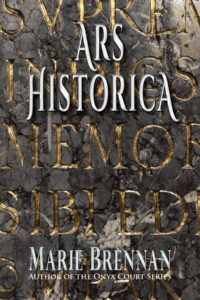
Ars Historica is now available for pre-order!

In ye olden days of publishing, short fiction tended to have a half-life of about .17 seconds. If you didn’t read it in the magazine issue where it was published, too bad; the issue went off the shelves, and unless you stumbled across it later or the story was reprinted in a “best of” or single-author collection, you might never see it again.

cover art for ARS HISTORICA by Marie BrennanBut with ebooks, that doesn’t have to happen, because collections are so much easier to do now. I’m pleased to say that Maps to Nowhere has been selling splendidly since it came out last month; next month it will be joined by Ars Historica, which collects my historical fiction and historical fantasy. I have more of these planned, too, but they’ll take a while — I have a wordcount range I’m aiming for in each collection, in order to make them roughly novella-sized, and the other three I’ve got planned all require me to sell another two stories or so (and then wait for those stories’ exclusivity periods to expire).

In the meanwhile, here’s the Table of Contents for Ars Historica, which you can pre-order from a variety of places here!

Table of Contents

Literary cocktails and mocktails

It’s 5 p.m. somewhere, right?

A few days ago the Tome and Tankard blog posted their recipe for the “Lady Trent,” a mojito-like cocktail inspired by the Memoirs of Lady Trent. Our first attempt at making it here at Swan Tower was not entirely successful; it turns out we need to be a lot more conscientious about mixing the honey into the gin before adding other things, lest we wind up with a glob of honey stuck all over with mint leaves. 🙂 But the general shape of the cocktail is a great deal like the “Jimi Hendrix” I asked the internet to help me recreate a while back, so even in less-than-entirely-successful form, I give this one an official thumbs-up.

And for those of you who cannot or do not wish to partake of the booze, I thought I could post the recipe a reader designed years ago for the launch party of A Star Shall Fall. It’s called the Winged Serpent Philter, and it’s made as follows:

  • Blueberry juice
  • Fresh blueberries
  • Lime
  • Lime infused sparkling water
  • Honey
  • Granulated Sugar

In a small bowl, mix two parts water and one part honey. Coat the blueberries (three or four per drink to be served) in the honey water mixture and immediately roll in granulated sugar. Allow to dry. Dip the rim of a martini glass in the honey water mixture and then into granulated sugar to coat the rim. Mix three parts blueberry juice to one part sparking water with a dash of lime juice (all liquids should be chilled). For a sweeter flavor, omit lime juice. Pour into the martini glass. Put three or four sugar coated blueberries on a garnish pick and hang on the rim of the glass. Add a curl of lime peel. Serve promptly.

Enjoy!

Spark of Life: David Walton on THE GENIUS PLAGUE

According to gossip, Clive Cussler hated the movie Sahara for exactly the reason I liked it: because the hero, Dirk Pitt, isn’t the suave unflappable type who shrugs off ridiculous action sequences as if they’re all in a day’s work. He pants for breath, whoops in joy when crazy plans work, and generally acts like somebody you would want to know. So I have to applaud this week’s Spark of Life guest, David Walton, for recognizing that it’s vulnerability more than sangfroid that can make us connect with a character.

***

David says:

cover art for THE GENIUS PLAGUE by David WaltonAction heroes are hardy folks. They run from fist fight to car chase without pause, shrugging off bullet wounds and never stopping for breath. But most of us aren’t action heroes.

In my latest novel, THE GENIUS PLAGUE, Neil Johns is no different than the rest of us. But his life is turned upside-down when his brother becomes the vector for a fungal pandemic that alters the minds of its survivors. Neil runs from crisis to crisis, avoiding those who would intentionally infect him, ducking terrorist bombs, trying to stop a war, and restraining his own father from murderous violence. It’s a breathless sprint, made all the harder by the anguish of watching those he loves succumb to the plague and become his enemies.

I hadn’t planned to write it this way, but at one point in the story, I realized it was all just too much for him. This guy wasn’t James Bond. He’d been eating poorly, he’d barely slept, and he could only keep it up so long. And so in a public hospital cafeteria, Neil breaks down. Once he starts crying, he can’t stop, all the pent-up emotions crashing in on him as soon as he takes a moment to breathe.

James Bond wouldn’t have done that. A traditional action hero would have found something extra-macho (and probably incredibly stupid) to do instead. But Neil is a mathematician, not a Navy Seal. He’s fighting this battle because he cares about his family members, not because he has something to prove. He’s an ordinary person, and ordinary people have limits to how much they can endure.

It was one of those moments when a character becomes real on the page with an authenticity that had nothing to do with the needs of the plot, and as an author, you have to recognize those moments and just go with them. When planning a novel, it’s easy to let the plot rule events, but sometimes the characters know better.

In THE GENIUS PLAGUE, that moment gives Neil a chance to regroup and gather his courage. And he’s going to need all the courage he can get for what’s coming. The plague impacts world politics, tearing governments apart from the inside, and putting control of the US nuclear arsenal in jeopardy. Neil is one of the few who understands what’s happening and has the knowledge to contain it, if he can manage to avoid being infected himself.

It wasn’t much: just a small, unexpected spark of life that pulled Neil off the page and made him more real, but despite its quietness, it turned out to be one of my favorite moments of the book.

***

From the cover copy:

In this science fiction thriller, brothers are pitted against each other as a pandemic threatens to destabilize world governments by exerting a subtle mind control over survivors.

Neil Johns has just started his dream job as a code breaker in the NSA when his brother, Paul, a mycologist, goes missing on a trip to collect samples in the Amazon jungle. Paul returns with a gap in his memory and a fungal infection that almost kills him. But once he recuperates, he has enhanced communication, memory, and pattern recognition. Meanwhile, something is happening in South America; others, like Paul, have also fallen ill and recovered with abilities they didn’t have before.

But that’s not the only pattern–the survivors, from entire remote Brazilian tribes to American tourists, all seem to be working toward a common, and deadly, goal. Neil soon uncovers a secret and unexplained alliance between governments that have traditionally been enemies. Meanwhile Paul becomes increasingly secretive and erratic.

Paul sees the fungus as the next stage of human evolution, while Neil is convinced that it is driving its human hosts to destruction. Brother must oppose brother on an increasingly fraught international stage, with the stakes: the free will of every human on earth. Can humanity use this force for good, or are we becoming the pawns of an utterly alien intelligence?

David Walton is the author of the international bestseller SUPERPOSITION and its sequel SUPERSYMMETRY. His novel TERMINAL MIND won the 2008 Philip K. Dick Award for the best SF paperback published in the United States for that year. He lives near Philadelphia with his wife and seven children.

an authorial self-indulgence

Back in July, I got an email from a reader in Sweden named Gillis Björk, saying they’d loved the Memoirs of Lady Trent so much, they were inspired to make a carved wooden slipcase for the series, and would I like to see pictures/a video of the crafting process.

WOULD I EVER.

In fact, having seen the slipcase . . . I sent Gillis an email, asking how much they would charge to make one for me.

Because seriously, the Memoirs are so damn pretty, with Todd Lockwood’s cover art and the three-piece cases and the deckled edges and so forth. Didn’t they deserve a good house to live in? It was a total self-indulgence, but I thought, hey, if Gillis was willing . . .

Behold the result! (Turn up the volume to hear the narration — it’s quite faint.)

It is even prettier than the original. We went for oak instead of beech, and Gillis got a lot more detailed with the carving of the dragons and so forth. At the end of the video you can see the slipcase on my shelf, with the books inside! And if you want to watch the making of the original version, that’s here:

Complete with accidentally-decapitated dragon and guidelines for avoiding spontaneous combustion. 🙂 These videos make for a fascinating watch if you enjoy seeing crafters do their thing; since I know bugger-all about woodworking and carpentry, they were hugely educational to me. And my endless thanks to Gillis for the lovely result!

In Better News

I recently signed up for an email service called “In Better News” (formerly, I think, “Kittens and Kindness”). Every day it sends an email with three pieces of news concerning people doing good deeds in the world, at various levels: everything from Coca-Cola giving men permission to break into one of their warehouses and take bottled water to help hurricane victims to a six-year-old girl setting up a lemonade stand with the goal of eliminating lunch debt at her school. Then, after those, you get three links to things involving cute animals.

It’s basically these tikkun olam posts, delivered to your inbox every day. With bonus cute animals.

Share with us your better news, however great or small. Your efforts to repair the world, one brick at a time, building a wall whose purpose is not to exclude but to shelter others from the storm. Donations, volunteering, random acts of kindness, alterations in your life that make you a better neighbor and friend. Anything to lift the spirit.

Remember Stanislav Petrov

Thirty-four years ago today, Stanislav Petrov saved the world.

As we struggle through the mire of war, as we wade ever deeper into the morass of armed conflict around the world, let’s take a moment to honor the guy who kept his head and prevented nuclear retaliation. He passed away in May of this year, but his memory should live on.

Catching up on New Worlds

My Patreon is trucking along, but I haven’t been good about linking to it here. So have a list of recent posts!

This week’s post (sneak preview!) will be on rites of passage, followed by a bonus post on the theory of worldbuilding, since that’s one of the funding goals we’ve reached. Remember, this is all funded by my lovely, lovely patrons — and if you join their ranks, you get weekly photos, plus (at higher levels) opportunities to request post topics or get feedback on your own worldbuilding!

So. much. TV.

I watch a surprisingly large amount of TV these days, because there is so much out there, and so much of it good. But I wind up almost never posting about any of it, because I have all these thoughts and then I don’t get around to writing the big long in-depth post. In lieu of that, have scattershot thoughts about things I’ve watched in the last year.

* I didn’t like the second season of Supergirl quite as well, due in part to me having zero interest in Mon-El. But man, that show is not remotely shy about wearing its politics on its sleeve, with episode titles like “Resist” and “Nevertheless, She Persisted” and plots about protecting resident aliens from attempts to deport them. So even though they have the occasional episode where everybody is phenomenally stupid in order to give Mon-El a chance to look smart (seriously, that one was so bad), it is balm to my soul.

* Frequency has hooked me surprisingly fast, with some good dialogue and a clever twist on what might otherwise be a bog-standard serial killer investigation plot: because the SFnal conceit is that the cop heroine is in communication with her cop father twenty years in the past, when she has him follow up on a lead, half the time she winds up changing the evidence out from under her own feet, e.g. going to a suspect’s house only to find out that in the new timeline he moved away nineteen years ago. Also, it turns out to be based on a film — but among other changes, they turned the father/son setup into father/daughter instead. Woot! Sadly, because everything I like gets canceled, there’s only thirteen episodes of it. (Currently we’re seven in.)

* The Defenders was decent, but distinctly uneven, in no small part because my god Danny Rand is just. not. interesting. (As I said on Twitter a while back, Iron Fist bored me so intensely that I didn’t even get far enough in to hit the unfortunate racism.) And unfortunately, he’s kind of at the center of the plot. On the other hand, watching the script take the piss out of him at absolutely every opportunity was kind of entertaining. And you could make a fabulous montage just of the reaction shots from Luke Cage and Jessica Jones.

* I have no idea what they’ll do with the second season of The Good Place, but dude, somebody made a comedy show ABOUT ETHICS. Like, actual philosophical discussions of what constitutes ethical behavior and how the various models of that differ. I am so there. Again. (I can’t believe it got a second season.)

* The Musketeers is far more entertaining than I expected it to be (though admittedly, my expectations went up when the opening credits told me it had Peter Capaldi). Of course it bears only a general relationship to the novel, being an episodic TV series, but it doesn’t have to warp the concept too far out of shape to work; the basic engine is the running political conflicts between the King’s Musketeers and the Cardinal’s Guards, with invented incidents to keep that rolling along. Capaldi is an excellent Richelieu, obviously scheming and ambitious without being a one-note villain (sometimes he and the Captain of the Musketeers work together). And the episodic format gives them some time to explore the individual characters. Much to my surprise, Porthos — usually my least favorite of the set — is really good here, in part because the actor is black and that is relevant to the character’s life story. A Porthos with depth, rather than just being the drunken comic relief? What is this madness??? Also, it’s doing reasonably well by its female characters, including making sure that the invented incidents have women in them, so you’re not limited to the recurring trio of Constance, Milady, and the queen. Yeah, okay, so I’m pretty sure Constance bears only the most passing resemblance to her novel incarnation — but since I like this version of her and have no particular attachment to the novel incarnation, I’m fine with that.

* Ascension was interesting, but flawed. Basic concept: A generation ship got sent out in the ’60s and is now halfway through its 100-year-journey, with tensions rising. The worldbuilding was intriguing, even as I wanted to beat characters about the head for some parts of it (seriously, who thought class stratification in a society that small and enclosed was a good idea?), but the end felt like it was a cliffhanger for a season 2 that, as near as I can tell, not only doesn’t exist but was never intended to.

* I feel like the seventh season of Game of Thrones was distinctly better than the sixth, transit time silliness notwithstanding. It registered on me as a better balance of major plot movement and the little dyadic interactions, which have always been one of the show’s strong points: the writers’ ability to put two characters together and have a fabulous scene happen, whether the flavor is hilarious banter or a flaming train wreck. Plus, Olenna Tyrell may have claimed the title of Most Badass Moment for the entire series. I mean, it was horrible. But it was also this phenomenally powerful, vicious interaction that played out as a quiet conversation between two people alone in a room, without any action spectacle whatsoever. Kudos.

* I enjoyed the first season of Lucifer, but the second took off like a rocket. Seriously, were the writers on a sugar high all season long? They just cranked everything up to eleven, and the result came to life for me in a way the earlier episodes hadn’t. I’m sad they lopped off the last couple of episodes to put them on the beginning of season three, because it meant I got less of what I was enjoying last spring, but from a narrative standpoint I can absolutely see why they did. That comes back in a few weeks and I’m looking forward to it.

* Also, more of The Librarians. One of the few things I fell in love with that hasn’t gotten canceled, even if I don’t think the third season was quite as good.

Has anybody else been watching these? Any recs for shows you’ve been enjoying? I’m primarily interested in stuff that is either SF/F or historical, and skewed more toward the “fun” end of the spectrum than gritty greasy grimdark. I am almost completely burned out on police procedurals, unless they’ve got a strong metaplot or a substantial twist from the usual model.

Today’s random gaming thought

You can tell how much an RPG system cares about a thing by how granular the rules for it are.

I’ve known this for a while, of course. RPGs evolved out of historical war-gaming, so many of them have incredibly detailed rules for combat, and much less detailed frameworks for other activities. But there’s another angle on this that I don’t think about as often, which is: when you get a bonus, how restrictive vs. broad is the application of that bonus?

In L5R, there’s a spell that gives you a boost to Perception-based rolls. All Perception-based rolls. Vision? Hearing? Scent? Reading people’s behavior? Commanding an army in battle? (For reasons of setting philosophy, that’s based on Perception.) This spell boosts all of them. Because although L5R is better at caring about non-combat stuff than some game systems, it’s really not all that interested in the finer-grained applications of Perception. Instead of having many spells that give you bonuses to different kinds of Perception, there’s one that hits them all.

Or Pathfinder. My PC has a magic item that gives a +3 to all Charisma-based skill checks, because Pathfinder, like most D&D, fundamentally doesn’t give a damn about social interaction. There is not, to my knowledge, a magic item that gives a +3 (or a +anything) to all Dexterity-based skill checks, because that would include Stealth (good for avoiding combat or taking the enemy by surprise), Acrobatics (good for avoiding attacks of opportunity in combat), Ride (good for anybody engaging in mounted combat), Disable Device (good for picking locks and disarming traps), and Escape Artist (good for escaping entangle and grapples in combat), among others. But handing out a cheap blanket bonus to Bluff, Diplomacy, Disguise, Handle Animal, Intimidate, Perform, and Use Magic Device? Eh, why not. That last is pretty much the only one that will often matter in combat, unless you’ve taken all the feats necessary to make feinting via Bluff a useful thing to do. And the game is relatively uninterested in what happens outside of combat.

And then you get players arguing that doing X isn’t very interesting. They’re right, in a way, because the rules have made it uninteresting. All you need is this single effect and you’re great at the whole shebang. But if the rules started from the assumption that X is interesting, and treated it with the same care and complexity of flavor they use for other aspects of play, it might be a different story.

(No game can do that for every single aspect, of course. If you tried, you’d wind up with something of unplayable complexity. But it would be nice to see that care and attention given to things other than combat more often.)

On cover art and Maps to Nowhere

I’ve gotten several compliments on the cover art for Maps to Nowhere, and wanted to take a moment to talk about it.

cover art for MAPS TO NOWHERE by Marie Brennan

For me, the cover is the hardest and most expensive part of doing an ebook. Because I’m a member of Book View Cafe, I work with a bunch of people who know how to do things like format them (Chris Dolley regularly does mine). And we have cover designers, of course; my own covers have been the product of efforts by Leah Cutter, Pati Nagle, and Amy Sterling Casil.

But that’s cover design. That’s figuring out how to stick the title and my byline on an image in a way that will be readable and attractive — and I’m very grateful for their help, because my image editing skills are all oriented toward photo processing, not drop shadows and embossing and knowing my way around eight million fonts. Before we get to that point, though, I have to answer another question: what do I want the cover to look like?

BVC can help with that, too, suggesting ideas based on the subject matter of the book or hunting through stock photo signs and DeviantArt to find possibilities. In the end, though, I’m the only one who can really say “yeah, that’s what I want” — which in practice means that I wind up doing most of the brainstorming and hunting myself, because I don’t feel like it’s fair to make someone else suffer through my “ehhh, uhhhh, maybe, I dunno” indecision. And depending on where you get the image from, licensing it will cost a sum of money ranging from a pittance to quite a bit; commissioning art is definitely on the “quite a bit” end. So: hardest and most expensive part of the ebook.

Which is why I’ve started casting a speculative eye toward my own photos. God knows I take enough of them; and while many aren’t suitable for covers (wrong orientation, too much noise, taken somewhere that doesn’t permit commercial use, etc) or the book itself is something that doesn’t lend itself to photographic representation (the Wilders books, frex), I’ve managed a few. In London’s Shadow uses a detail I shot of the clock on the Rathaus in Basel, Switzerland; the upcoming Ars Historica collection will use another image from that trip, a closeup of an inscription in a church. Dice Tales is built from a die photo I took specifically for the book, which Leah Cutter then photoshopped to change the top four faces, and a block of text I put together for the background, because it was that or staging the equivalent of the Writing Fight Scenes cover with some dice in place of the sword.

But for Maps to Nowhere?

I had nothing.

I didn’t have any particularly good map photos, because those are almost always taken for reference purposes, not aesthetic ones. I knew I wanted something that would suggest another world, and you’d think I would have that . . . but most of my travel, especially since I got any good at photography, has been to cities. Gardens I can do, but actual natural landscapes? Not so much. I assembled a handful of possibilities — three of which are are variants on the mossy slope that forms the backdrop of my website — but none of them clicked.

So I called up my parents.

They’re the ones who got me into photography, because they got into it before I did, and are better than I am on many fronts. And they travel a lot, including to lots of spectacular natural places. I explained what I wanted and why; they gave me a pile of photos; and that easily, I had my cover. One of my father’s favorite shots from their trip to South America a few years ago is of a place called Torres del Paine in Patagonia, where he had caught the warm light of sunrise on the Paine Massif, with mist blurring the mountains and the sky and water bracketing it all in cool blue. It’s striking, it’s otherworldly, and it’s exactly what I wanted.

I owe Pati Nagle thanks for turning the photograph into a cover, Chris Dolley for the formatting, and Phyllis Irene Radford for proofreading the collection. Vonda McIntyre and others checked the formatting, and the entire BVC co-op stays vertical and functioning because its members put in quite a bit of hard work to make that happen. But this time I have to add my father to the list, because if that cover makes you feel like you’re about to go somewhere magical, it’s because he caught that moment with his camera, and let me share it with you.