Books read, July-August 2022
I missed reporting on July, didn’t I?


I missed reporting on July, didn’t I?
Once again my loyal Topic Builders of the New Worlds Patreon have voted: for September, we’re turning back toward war! Specifically, the idea of there being different kinds of battles that aim to accomplish different purposes, with raiding first up on the list. Comment over there!
The New Worlds Patreon discussion of slavery wound up spreading across two months rather than the original plan of one, but it concludes at last with institutions that bear some resemblance to aspects of slavery. Comment over there!
Okay, we’re making a thing!
. . . how do we do that?
Step one is to figure out what I want this strap to look like. As I said before, card-weaving can do much more complex patterns than inkle-weaving — but it’s still limited by what you warp onto the loom, so you need to plan ahead. And there’s an extra twist (pun not intended, but very apropos), in that if your pattern doesn’t involve rotating the cards backwards as well as forwards, over time you’ll twist your unwoven warp threads into little ropes. Because I want to keep my first project simple, I went digging through different patterns both in my book and online, and settled on one that’s the tablet version of the “chain” pattern from inkle weaving — same idea, but (because of how card-weaving works) less tightly compressed.
This required me to generate a warping draft. Doing this for inkle-weaving is easy; you have only two kinds of thread (leashed and unleashed), so putting those on separate lines and using different letters to represent the different colors, a single chain pattern looks like this:
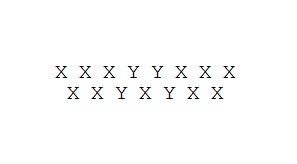
With a card loom, though, you need to plan four threads for each card. Furthermore, it matters whether the threads are warped “up” or “down” — that refers to the direction in which they pass through the card. I wound up making a spreadsheet with cells deliberately shaped to be taller than they are wide (to represent how the threads will look as they’re woven) and color-coded to imply the colors of the threads, and produced this draft:

The letters on the left tell me which hole in the card gets which thread, and the little v’s and carets tell me whether to warp up or down. To weave this, I will first rotate the cards forward four turns, then backward four turns, so I don’t wind up with twisted warps making life difficult at the end of the project. The nice thing about the spreadsheet is, I can copy-paste to make an expanded version that gives me a sense of what the final product will (hopefully) look like:

Now, there’s a key piece of guesswork going on here, which is the question of width. How wide your fabric is depends both on the number of threads and the thickness of those threads. Back in my inkle-weaving days, I was decent at eyeballing this . . . but that was a looooong time ago, and also I have zero experience with how this whole four-threads-per-card thing is going to work, with them twisting around each other and all.
Is this a reasonable number of cards for the project? I have no idea. The thread I bought is very fine, so I’ll definitely need more than with some of my projects of yore. But I am straight-up guessing with the draft you see there.
The good news is, I have some leeway to experiment. I don’t want to put a very short warp on the loom and just test-drive with a piece I’ll have to throw away (though it would probably be smart of me to do so), but I suspect my loom isn’t large enough for me to weave all the material I need in one go anyway. (Your material inevitably gets shorter as you weave it, because what were formerly straight warp threads are now going over and under the weft.) So I can weave this, and if it’s too skinny or too broad, I can use it for the “equatorial” straps that go sideways around the box. Then round 2 can be adjusted, and I’ll weave the big loop that will be the one I’m holding in my hand.
But this has introduced one wrinkle to the process. When I originally made my draft, it was narrower — an alternation of three-and-two on the chain, instead of five-and-four. I widened it upon receiving the thread and realizing how slender it was. Alas, I do not own enough cards for the wider draft; I have had to order more from Etsy. I’m waiting on those to arrive . . . and then the warping can begin!
Apropos of my earlier post — really, what I need are more environmentally friendly ways of doing the developmental stages. I had some very productive thinking time while showering, and more while driving to and from the city, but I can’t just do those things on a whim to make my brain work!
I genuinely think that my job got harder when I switched over to writing full-time, but not for the reasons that usually get cited: when I was in college, when I was in grad school, I spent a fair bit of my life walking to and from class. That was excellent thinking time. But these days . . . yes, I realize I could just go for walks. It isn’t the same, though? Walking just for the sake of walking feels like it’s me trying to hide the fact that I have scheduled this period for Thinking About the Book, which isn’t effective. It works better when I’m walking for some other purpose. Like errands — but a combination of pandemic + foot problems means I haven’t even done as much of that lately.
Maybe I should take up gardening. 😛
In all seriousness, one of the trickiest things about writing as a line of work is the part that doesn’t look recognizably like work.
I’m currently in progress on a background project, and I’ve had to accept that as much as I would like to be charging ahead and putting words down on the page, doing that right now stands a high chance of producing material I’ll just have to cut later. I need to think. I need to figure out plot beats that will be lively as opposed to merely getting the job done. I need to make sure I intend to stick with my current idea about how magic works in this setting, because I’ve already tweaked it once, and you know what’s not fun? Invalidating a chunk of narrative because things don’t work that way anymore.
This is necessary work — but it is also work that does not lend itself to metrics. It is the opposite of effective for me to set a timer and say, okay, for the next hour I am going to Think About the Book. Nor can I really set a goal where by the end of the week I need to have a clear sense of a particular character and how they’ll get involved with the plot. Trying to set that kind of goal is a really, really good way to make my brain freeze up and produce nothing at all.
And even when the ideation does happen . . . at what point am I allowed to kick back and say, okay, done for the day? I can set a baseline for drafting: for me it’s usually a minimum number of words, but for other people it’s a certain amount of time at the keyboard. Either way, when you hit your goal, you’re done. (If you want to or have to be. There are days when I hit that goal and keep going just because I’m on a roll; yesterday was one of those days.) Thinking, though . . . how do I decide that I’ve made enough intangible progress, and now it’s okay for me to slack off and watch TV? And even if the answer is that I should do more work, how do I do that when the best way for me to think is to be doing something else? Only certain kinds of something else count; TV isn’t a great one. Neither is reading or playing a game. Showering’s great, but we’re in a drought here, so I can’t just take three a day and see what happens.
I dunno. I’ve been doing this stuff for years and I still dunno. I have a good plot bit, though — something that will introduce a bit of action and set up some complications for my protagonist. I still don’t know much about one of the characters involved in it, which is bad because they’re supposed to be moderately important to this story . . . so I guess I have more thinking to do. Eventually.
Maybe tomorrow, when I’m in the car.
I have a whole pile of projects right now that I am either not permitted to discuss (as in, there’s an NDA and everything) or superstitious about discussing until they reach a firmer milestone. In one particular instance, this means I have not only drafted an entire novel but sent it to my editor, gotten comments in return, and sent back the revised manuscript, all without being able to say a word about what I was working on.
But as of today’s official announcement, that FINALLY changes!

The Game of 100 Candles is, as the title suggests, a sequel to The Night Parade of 100 Demons. It takes Ryōtora and Sekken to Phoenix Clan lands, and from the rural wilds of the mountains to the heart of a powerful provincial court — where more supernatural matters are afoot . . .
This will be out in February of next year!
As of me posting this, the Uncanny Magazine Year 9 Kickstarter has six hours to go. They’ve achieved all their listed stretch goals, but I want to note that the last priority in every Uncanny fundraiser is “pay the people who run the magazine.” Lynne Thomas and Michael Damien Thomas pay their staff before they pay themselves . . . but they’ve built Uncanny up to be one of the most admired publications in the field, and they deserve a reward, too. Not only that, but their daughter has had some serious medical expenses recently — so if you can back the Kickstarter, signal-boost it elsewhere, or both, please doe!
The New Worlds Patreon can’t end its discussion of slavery with slavery itself; there’s also the question of what happens to people after they get out of such bondage. Comment over there!
I have in my possession a lovely “writing box” from Galen Leather. (If this looks familiar to some of you, yes, it’s because Yoon Ha Lee also owns one. He posted about it, I put it immediately on my wish list for future gifts, and eventually it came back into stock, whereupon my husband got it for me.)

I have only one real complaint about the box, which is has to do with the strap. It snaps around the box, and while over time the use of the strap has caused the leather to stretch a little and make snapping easier . . . it’s still an annoyance, requiring me to carefully line up the various bits.

After taking the box to the Sirens conference and wrestling with it there, I had an idea for an alternate design: rather than something that holds by snapping closed, why not what amounts to a kind of net bag that can just slide over the box?
This led my thoughts in . . . certain directions. Before I chased that particular rabbit, though, I needed a proof of concept. So I went to the store, bought some sturdy woven strapping, and sewed an example of what I had in mind.

Yep, that works. Took the box to Worldcon and found this approach much less annoying than the snap-shut leather strap. But, well. It isn’t very attractive, is it?
. . . I can fix that.
Probably very few of you know that I know how to weave, because I haven’t done it since, uh. <does some math> <carries the one> . . . 2004? Give or take a year? Let’s just say I haven’t done it in a Rather Long Time. And specifically, what I know how to do is inkle weaving, a method that is ideally suited for producing long, narrow strips of material.
But. Inkle weaving, while useful, is also limited. At its core, it produces a binary pattern: one row of the material will look like A, the next will look like B, and then rinse and repeat until you run out of thread warped on your loom. The technique of pick-up weaving lets you break up the alternation, but it’s still limited, and it has a downside; “picking up” a given thread means it doesn’t get secured by its over-and-under dance with the weft, and the more rows you pick it up for, the longer it’s left floating above the fabric (and the less actual fabric there is in your piece, just a weft thread shooting through the void). So you can’t do very complex patterns with inkle weaving.
Meet my friend.

This is one of my looms. (I have three. Yes, I know I haven’t woven anything in nearly twenty years. Shut up.) It’s nice and sturdy and it has a pocket to put the shuttle in, but for our purposes here, the reason I’m showcasing this one is that it has a very interesting feature. That vertical central post?
That can be removed.
And when you remove it, you don’t have an inkle loom anymore. Instead you have something that can be used for card-weaving.
Card-weaving, aka tablet-weaving, is similar to inkle in that it produces long, narrow strips of material. But its patterns aren’t binary: every card has four threads running through it, and by rotating the cards backward and forward, you can change which two are visible (on the top side and underside of the fabric) at any given time. Depending on how you’ve warped the loom and what you do with the cards, you can produce quite complex patterns.
Sounds nice, doesn’t it? Let’s pretend I actually understand what I said above. I mean, I understand what I said; what I don’t really understand is how it works. The geometry of what’s happening on an inkle loom is simple. The geometry of a card-woven piece, less so, because the threads are twisting around one another while diving up and down through the fabric. And, well. I’ve never card-woven anything before.
I mean, I have a little. Sort of. The friend who taught me to inkle-weave at one point also gave me her battered old card loom with a piece already warped on it for practice (that’s how I wound up with a third loom) and a book on the technique. I noodled around with it a tiny bit, but I wasn’t the one who’d warped the threads onto it, so I’d missed the chance to internalize that part of the process, and I didn’t know what I was doing. Eventually I cut the material off the loom, and it’s been gathering dust ever since.
If I want to weave a nice-looking carrying strap for this writing box, though, card-weaving is the way to do it.
I still have a loom. (Three of ’em, in fact, which is not especially helpful.)
I still have the book.
I have the internet to help.
I am going to try my hand at card-weaving, to make a strap for the box.
Wish me luck. I will report back as the process continues.
Having discussed runaway slaves and rebellions last week, the New Worlds Patreon now turns its attention to the legal side of getting out of slavery . . . or ending it entirely. Comment over there!
I originally thought the New Worlds Patreon would get through the topic of slavery in one month. Since I was very wrong about that, for August we’re returning to that subject, starting with runaway and rebellious slaves. Comment over there!
How many of you have That Idea — a story, or piece of art, or music, or whatever — that you know you’re not quite good enough to pull off yet?
Last night I finally said to someone outside my skull that I have one of those. The earliest roots of it, I realized, go farther back than I thought; all the way to high school, in fact. I really wasn’t tall enough to ride that ride at the time, and so the concept never went anywhere other than swimming around in my brain and me jotting down, over a period of years, quotations to feed it in my brain. More recently I’ve taken a semi-stab at it, in totally different form, and the semi-stab isn’t bad, but I don’t think it’s quite what I want it to be. I could try again, but I have that fallow feeling, the one where I need to just let this live in the back of my brain and quietly accumulate some more quotations and thoughts and stories that will nibble around the edges of the idea without trying to swallow it whole, not just yet.
I’m not quite tall enough to ride this ride. Which can sometimes be a dangerous thought to accept, because the way we grow taller for this sort of thing is by doing; if you tell yourself “oh, I’m not good enough for that yet,” you may never get good enough. Sometimes it’s better to try anyway. But — depending on your own personal brain installation — it may be the case that trying and failing with that particular idea means the seed is now dead; you’ve used it up and gotten not nearly enough for your efforts. I’m hoping I haven’t done that with the aforementioned semi-stab. Over the years I’ve gotten a lot better at meaningfully reshaping a story in revision, and I’ve had at least a couple of short fiction instances of me taking a new run at an idea that fell flat the first time, so there’s reason to think I might be able to try this one again. For other people, though, the risk is real. In which case you have to trust yourself to figure out which seeds should be left to germinate for longer and which ones can be used as fodder for growth.
Yes, I know I’m talking vaguely around the actual thing in question. That’s because I have hangups about discussing nascent ideas in public. But if others among you have your own instances of this kind of thing, it would be pleasing to know I’m not alone.
For its sixth year, the New Worlds Patreon is devoting its theory essays to the question of how to design a magic system — starting with calling into question that entire notion of a “system” to begin with. This time around, we look at some of the underlying principles that govern real-world ideas of magic; comment over there!
The New Worlds Patreon has discussed calendars before, but there was one aspect we missed: the cultural significance we attach to them. Comment over there!
This is as much for my own records as anything else, but it might be useful to others, so I’m posting it here.
When preparing a list of names and terms to send your copy-editor, it helps a lot to do the following.
If you are writing a series:
I learned at the CE stage of The Liar’s Knot to create the master list. I learned at the CE stage of Labyrinth’s Heart that I should have been numbering all the items so I’d know whether a lack of numbers meant that it showed up in both of the first two books, or that it got introduced for the first time in book two. (That part probably isn’t necessary, but my brain wants it.)
You could probably just inflict the whole master list on your copy-editor each time around, but given how much these names and terms pile up, I feel like it’s better to give them only the relevant selection, without cruft leftover from previous books.
Or, I mean — you don’t even have to make a list. I didn’t for my first I don’t know how many novels, until I heard this was a helpful thing to do. It’s especially useful to you as a writer when you’re writing more than one book, because of how it can double as a minimalist series bible. And if you’re going to make such a list, this workflow minimizes the amount of mental effort that goes into finding all the names and terms. It’s still time-consuming, but it isn’t hard.
I’m delighted to announce another sale to Beneath Ceaseless Skies: “Constant Ivan and Clever Natalya,” which I describe on that page as me going Full Metal Folklore with the Rook and Rose setting. 😀
Ours is a highly precise world — so much so that we tend to forget that units of measurement aren’t some naturally-existing thing, and that it takes a lot of work to keep them accurate. The New Worlds Patreon takes a look at weights and measures; comment over there!
A bit belated on account of me being on vacation; a bit short on account of June being the month of Revise All the Books.
Be honest: how much do you rely on your phone to do math for you these days? We’ve long had assistive devices to help us perform mathematical operations, and this week the New Worlds Patreon takes a look at some pre-electronic ones. Comment over there!
