Sign up for my newsletter to receive news and updates!

Archive for the ‘Uncategorized’ Category

In which I am Featured

So I just discovered that my biography there is painfully out of date, but I am a Featured Author this month at Anthology Builder.

It’s been a while since I mentioned them here, so for those just tuning in: AB is a sort of iTunes-style service for buying short stories. Their database includes a large (and continually growing) number of stories by a wide variety of authors, both current and classic; what you do is go through and pick out the pieces you want until you have somewhere between 50 and 350 pages, your own custom-designed anthology. AB prints it up for you and mails it off, the authors get a cut of the price, everybody wins.

(At present there is no e-book option, but they’re looking into implementing something along those lines.)

What does it mean that I’m a Featured Author? It means that for the month of May, if you order an anthology with one of my stories in it, you get a dollar off the price. I’ve got twenty-one stories in their database — pretty much all my short fiction from 2008 or earlier, including Deeds of Men — which adds up to enough for a collection of my work, or you can mix one or more of my pieces with stuff by other authors. They have stories by Tobias Buckell, Aliette de Bodard, Marissa Lingen, Ruth Nestvold, Tony Pi, Cat Rambo, Janni Lee Simner, Martha Wells, and a whole lot of others; those are just a few of the names I recognized in a quick scan of the list. So there’s plenty to choose from. I’ve used the service a couple of times myself, and quite like it, so wander over and take a look for yourself.

Books Read, April 2011

A longer list than March’s, but the post will be shorter, because the DWJ books have all been discussed elsewhere already.

(And while it may be a longer list, I’m not sure it amounts to more pages read. March included a Wheel of Time book, and a bunch of Bujold; April is lots of DWJ and two graphic novels. I won’t be surprised if this turns out to be more like my usual level, as opposed to January and February, where I was mainlining books like a woman who hadn’t read much fiction in, well, ages.)

Now let’s see if I can remember these . . . .

The DWJ Project: The Homeward Bounders

We’re almost at the end of the Diana Wynne Jones books I wrote recommendations for; this is the last but one. (The final title is Eight Days of Luke, which is also a favorite, but it’s sort of a first-and-a-halfth tier favorite, along with Archer’s Goon and The Power of Three and maybe some others, too.)

So that link has the plot summary and so on. Here, outside the spoiler cut, I’ll say that the only DWJ novel that has ever seemed to me at all similar to this one (and vice versa) is Fire and Hemlock, though I’ve heard people talk about a few others in a way that makes me think I may change that evaluation, once I remind myself of what those others are like. Partly it’s the role of real-world folklore — though in this case the components are easy to spot, since many of them are named in the opening paragraph. The Wandering Jew. The Flying Dutchman (whose ship is on the cover of my edition). Him, whom I won’t name here because this is the non-spoiler part of the discussion, but those of you who have read the book know who I’m talking about. Then again, there may well be other layers that aren’t so obvious to spot.

But really, what makes this one feel akin to Fire and Hemlock is the way it sort of slantwise approaches some really thorny things before turning to look at them directly, without flinching. Neither of these books is precisely happy. They both end on a note of hope, but it’s tempered with some real sorrow, the victory coming at a fair bit of cost. I’m really sort of startled this counts as a kids’ book, even if the protagonist is twelve. But kids need stories of this kind too, I suppose — even if it leaves me, at the age of thirty, feeling like somebody has stomped on my heart.

I think that’s all I can say that’s non-spoilery. Follow me behind the cut for the rest.

(more…)

Guerrière

Lirez-vous français?

If you can read the above sentence and the answer is “yes” (or rather, “oui”), drop me an e-mail at marie[dot]brennnan[at]gmail[dot]com. I have two copies of Guerrère — i.e. the French-language translation of Warrior — looking for good homes. (No residents of France, please; I’d prefer to send them to people who can’t find the book in their local shop.)

Happy International Pixel-Stained Technopeasant Day!

Once again, I celebrate the holiday founded by papersky, International Pixel-Stained Technopeasant Day, wherein writers are invited to share bits of fiction for free online, and thereby prove that this does not cause the sky to fall.

This year I’ve decided to post one of my favorite stories: “Nine Sketches, in Charcoal and Blood.” It’s a favorite because as I was on my way to VeriCon one year these characters wandered into my head and immediately struck up a conversation that hinted at but never said outright all kinds of fascinating things about who they were and how they knew each other and why they had come together again after a long absence. Never have I had such a strong feeling of uncovering a story that was already there, rather than making one up — and hell, I still wonder what some of the things are that they never got around to telling me.

This year, I’d like to make it interactive, too. Leave a comment telling me about free, online fiction you’ve really enjoyed lately, whether a specific story or a particular market or whatever. I read Beneath Ceaseless Skies regularly, but I’d love to gather a bunch of other recommendations, and maybe find some new authors or markets to read. So share the love in the comments, and happy Sant Jodi/Shakespeare’s birthday/Thumb Your Nose at Howard Hendrix Day.

The DWJ Project: Howl’s Moving Castle

When I started these posts, I had to decide on an icon. I can no longer remember what cover was on the copy of The Lives of Christopher Chant I read back in the day, and sadly, my memory of my original Fire and Hemlock cover turned out to be way cooler than the reality. (In my head, it looked a lot more like the photograph is described. I would pay so much money to see Diana’s actual Fire and Hemlock picture.)

But I remember the cover under which I first read Howl’s Moving Castle. It’s the one you see in this icon, and while Howl himself doesn’t look right, that is Calcifer. (One of the many reasons I was disappointed with Miyazaki’s film is that Calcifer, while adorable, was utterly wrong.) So, since I wanted an icon that might actually be recognized as Diana Wynne Jones-related, this was the natural choice.

Since I’ve started to begin this project by re-reading my first tier of favorites — I don’t have a favorite, one that stands out above all others — I will once again point you at the recommendation I wrote some time ago, which gives you a sense of the plot. This one is much more fairy-tale-ish in its flavor, firmly set by the opening paragraph’s proclamations about the misfortune of being born the eldest of three. Its hard edges aren’t as prominent, either, as in the previous two books; there are some unpleasant notion lurking in the whole business with the fire demons, and also in what happens with Mrs. Pentstemmon (not to mention Prince Justin and the Wizard Suliman), but there’s less that makes you squirm and think, um, these people aren’t entirely good, are they? Howl’s faults, while real, are also less sharp-edged.

But it’s a Diana Wynne Jones book, and that means it also has some interesting truths about people’s behavior. I saw somebody’s post talking about how Christopher gets smacked upside the head by Flavian’s outburst in Lives, and so, in a way, does the reader; there’s a similar kind of reversal here with Fanny, as Sophie’s mental image of her (and the reader’s) changes from the beginning to the end of the book. Sophie’s own motivations are for a time unclear to her, and Howl . . . well, let’s just say that I’m wondering if my childhood fondness for this book somehow primed me to like Francis Crawford of Lymond. There are some unexpected similarities between the two.

I’m wandering close to spoiler territory, though, so I’ll put the rest behind the cut.

(more…)

Tune in for the thrilling conclusion!

The second half of Dancing the Warrior has gone live.

If you missed the first half, it’s here. If you missed the post about what this story is, that’s over here. If you want to know the story behind the story — i.e. where this thing came from — that’s up on my website. And if you’re interested in winning a signed copy of both doppelganger novels, but haven’t yet chimed in on the comment thread with your Hunter name, never fear; there will be a second drawing two weeks from now.

Enjoy!

The DWJ Project: Fire and Hemlock

This is the other book that had to be put up at the top of the reading order: The Lives of Christopher Chant because it’s the first one I read, and Fire and Hemlock because it is, as I’ve said before, the book that made me a writer. Since this month is the five-year anniversary of my first novel being published, the time seemed very right to re-visit it.

As with Lives (and a few others to come), I’m going to cheese out a bit on writing up broad commentary and just point you at my recommendation from 2004. This is, as I say there, a “Tam Lin” story (and a “Thomas the Rhymer” one, too); it’s because of this book that I picked up Pamela Dean’s Tam Lin, which in turn became one of the foundational inspirations of the first novel I ever finished writing. But it isn’t a straightforward retelling of either of those stories. It is, instead, its own riff on the idea, with its own twists and solution.

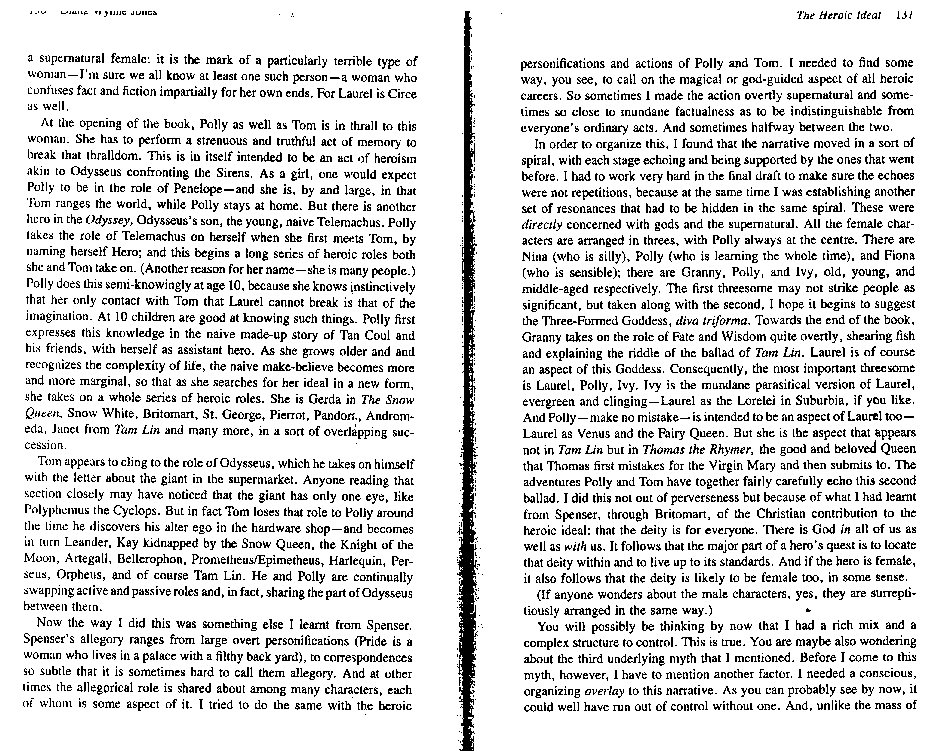
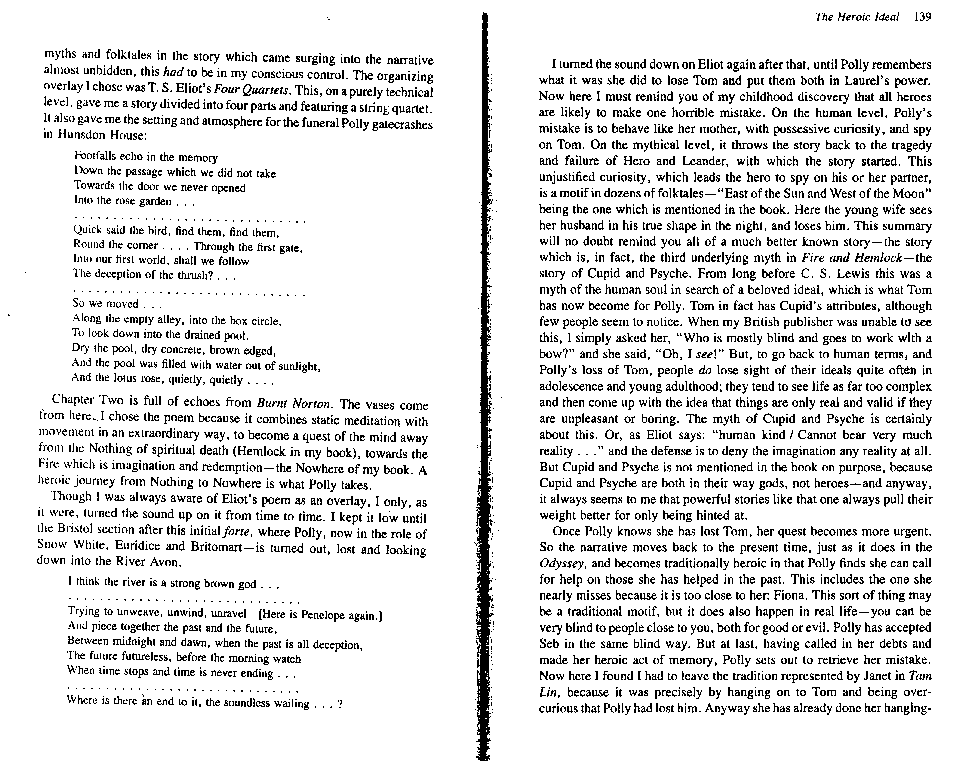
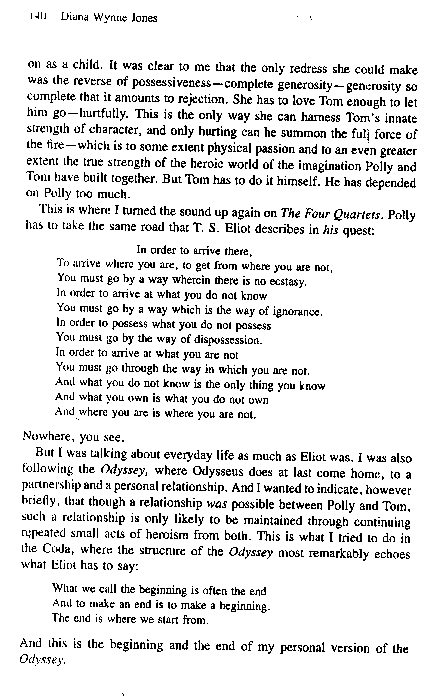
For many years, I would have told you I didn’t understand that solution. In some ways, I still don’t — I mean, I kind of do, but slim as this novel is, I never feel like I can quite hold the entire shape of it in my mind at once. Bits keep slipping through my grasp. This used to bother me a lot, and I blamed it on the fact that I first read the book when I was nine; having gotten a certain form of not-understanding into my head, I couldn’t let go of it and see what was there. Then I read this two-part post by rushthatspeaks, and that referenced an old essay by Diana Wynne Jones that I was able to find online (pages 1, 2, 3, 4, 5, 6, 7), and you know what? I no longer feel the slightest bit ashamed of not being able to comprehend this whole book at once. The layers that went into it boggle me: not just “Tam Lin” and “Thomas the Rhymer,” but the Odyssey, and Cupid and Psyche, and a T.S. Eliot poem I’d never read that turns out to be quite important, not to mention all the trios I’d never consciously thought about, Nina/Polly/Fiona and Granny/Ivy/Polly and Laurel/Polly/Ivy. Re-reading it this time, I bent my brain in half mapping out similar trios among the men. The novel is worlds more complicated than I ever consciously noticed before.

(In case you didn’t guess, you shouldn’t read those essays without having read the book first. Spoilers, and a lot of stuff won’t make sense.)

I never thought of DWJ before as the sort of author who would do that kind of intricate weaving within a narrative (hah, the irony of deploying my usual textile-based narrative metaphors for this). I’ve always known she was an incredibly strong storyteller, but now I find myself wondering if I’ll spot anything as elaborately layered in her other books, or if Fire and Hemlock is going to stand apart from the others in that regard. I know it’s always felt different; only The Homeward Bounders ever seemed comparable to me. But as I go back for this project, I may find it has other cousins among her work.

Okay, behind the cut for more spoilery bits.

(more…)

a question for the raver-types

I’d like to attach EL wire to the edge of a fan, but I suspect it wouldn’t like being doubled up when the fan folds. Am I right about that? Any suggestions for how to get a cool glowing edge by other means?

(What I really want is for the fan to light up automatically when opened, and go dark when folded. But I suspect that would require rather more engineering than I’m capable of, or want to do.)

Signal Boost: Vera Nazarian

Details are here, but the short form is that Vera Nazarian (of Norilana Books) has lost her multi-year battle to keep her house, and is having to move across the country with her sick mother and four pets.

Norilana is the publisher that puts out the Clockwork Phoenix anthologies, all three of which include stories from yours truly. (“A Mask of Flesh,”, “Once a Goddess,”, and “The Gospel of Nachash.”) I’ve read all three of them, and think they’re quite excellent volumes, quite apart from my personal investment. Norilana has also done a number of other books, including the continuation of the Sword & Sorceress anthology series, a few classic novels, some fantasy, some science fiction — check out Vera’s post for a whole lot more. She could use the business right now, and Norilana’s got some great stuff, so if you’re inclined to pick up new reading material, head over and take a look.

AROTGOTTVSP,AWBSNSFAPOAPCFTFG

A Review of the Game of Thrones TV Series Premiere, As Written by Someone Not Starting from a Position of A Priori Contempt For the Fantasy Genre

(LJ won’t let me have a post title that long.)

I thought it was pretty good. The three of us watching who had read the books thought it was a faithful and effective adaptation of the source material; the fourth member of the audience, who had not read the books, said it succeeded at getting her interested, which is what you want from a premiere. Lots of good casting choices, and because it’s a series, it can take the time it needs to build up the characters and the world by methods more gradual than Ye Olde Info-Dumpe.

It being HBO, of course, they were not shy about showing you the nekkid, and things that were faintly disturbing on the page become moreso when you actually see them happening. (In particular, it’s hard to miss how problematic the Dothraki are.) But I didn’t feel they were gratuitously amping the R-rated stuff up just for the sake of spectacle, which is my usual HBO complaint.

I definitely want to see more. Though we’ll probably go the route of recording several eps and then watching them in one go, rather than doling it out an hour each week.

And that, New York Times, is how you do it. You get a reviewer who actually likes the genre to give you an opinion. Not somebody who is convinced of the worthlessness of fantasy before they ever sit down to watch the show. Please remedy this error in the future.

The DWJ Project: The Lives of Christopher Chant

After much hemming and hawing, I decided that I needed to start the re-read with The Lives of Christopher Chant, as it was — so far as I recall — the first DWJ book I ever read.

So I think what I’m going to do with this project is post an entry for each book, and put the non-spoilery stuff up top, then hide the spoilery stuff behind a cut. (I’ll put in a warning, for those reading this by RSS feed or other methods that might show the whole entry at once.)

Mind you, it’s hard to know what to say. I love this book in that unreserved way you can generally only get by forming your attachment in childhood, when things can bypass your brain and go straight to your heart. The easy thing to do is point you at the recommendation I wrote back when I was doing those on a monthly basis — with two corrections, those being that I spelled Throgmorten’s name wrong there (how could I make such a mistake?) and somewhat mis-spoke on what constitutes the unifying thread of the story. It’s really more about Christopher’s spirit travels than it is about the Chrestomanci business.

If you want an introduction to Diana Wynne Jones’ work, I’d say this is a good place to start. It has a lot of her hallmarks: children with more power than they’re initially aware of, hard bits the story doesn’t flinch away from, choices with consequences. It also sets you up for the rest of the Chrestomanci books, all of which take place later, though half of which (Charmed Life, Witch Week, and the Magicians of Caprona) were written sooner. (When I get to Charmed Life, I’ll have more to say about the chronological relationship of those two.) I really love the concept of the Related Worlds, and the notion behind just how nine-lived enchanters come to exist, and I also love the way the story seems to go beyond the boundaries of the frame. Just how did Cosimo Chant and Miranda Argent end up married, anyway? What happens with Fennig and Oneir after Christopher leaves school? What’s the tragic tale of Mordecai Roberts and Miss Rosalie, before the book begins? We get hints, but nothing extensive, and if you tell me there’s fanfic out there answering those questions, I won’t be at all surprised.

But the stuff I really want to say involves specifics, so let’s go behind the cut for that.

(more…)

I think I’d prefer a Marlovian film.

It had to happen eventually, I suppose.

SCENE: The inside of swan_tower‘s head

SWAN: Let’s go look at movie trailers. Anonymous — what, like the group?

PAGE: <loads>

SWAN: No, it’s something set in Elizabethan England! With Derek Jacobi and other cool people! <reads further in synopsis> . . . oh, shit. It’s a “Shakespeare didn’t write Shakespeare’s plays” story.

TRAILER: <plays>

SWAN: Old London Bridge! <swoons in a fit of historical geekery>

DIRECTOR: <is Roland Emmerich>

SWAN: grk.

IMDb: This movie’s theory is apparently Oxfordian, since Rhys Ifans has top billing, and he’s playing Edward de Vere.

SWAN: <sigh> But . . . London Bridge . . . Elizabethan geekery . . . but Roland Emmerich. And Oxfordianism. <more sigh> Well, at least it seems I’m over my knee-jerk “please god no more” reaction to the sixteenth century. And that’s something. Whether or not I can bring myself to watch this movie . . . we’ll have to see.

Writing Fight Scenes: Maps

[This is a post in my series on how to write fight scenes. Other installments may be found under the tag.]

After a delay of much longer duration than expected, I finally have for you a follow-up post on the topic of where to set the combat, which will function as our segue into craft-related aspects of writing fight scenes.

If the layout and contents of the environment are important to the scene — as they should be — then you need to have a very clear grasp on their relative positions. It doesn’t guarantee you’ll communicate that information effectively to the reader, but believe me: if you don’t have that clear grasp, your odds of communicating the necessary information go way down.

To that end, I suggest making a map.

It doesn’t have to be fancy. Mine, in fact, are hideous. Let me show you, with three examples from Warrior (the novel formerly known as Doppelganger):

Nobody ever has to see them but you. Unless, of course, you decide to write a series of posts on the topic of fights, and use your own work as a demonstration.

more Scion tidbits

I’m a bit proud of this idea from the game I’m running, so I wanted to share. It will make the most sense to those who already know the cosmological setup for White Wolf’s Scion system, but for everybody else, I can quote the nutshell description I gave when I posted about my concept for the game:

The underlying enemies in this scenario are the Titans, the parents of the gods themselves. They’re truly impersonal, elemental powers: the “body” of the Greater Titan of Fire, for example, is more or less equivalent to the D&D Elemental Plane of Fire. However, Greater Titans can manifest more concretely as avatars, which are god-like beings reflecting a particular aspect of their concept. Prometheus, for example, is an avatar of the Greater Titan of Fire; so is Kagu-tsuchi, but they embody different things. The Titans aren’t precisely evil, but they’re not friendly to the world, and their influence usually isn’t a good thing.

Got that? So, it mentions in the books that some of the Titans were never bound. Hundun because it’s the Greater Titan of Chaos and can’t be bound; Logos because the Greater Titan of the Word struck a deal with the gods. Etc.

I was trying to decide what to do with the Mississippi River, cosmologically speaking. I failed to turn up any useful info on how tribes along its length viewed the river — no deity names or anything — and I knew “Old Man River” was a relatively late concept, but at the same time it seemed necessary and appropriate to have some kind of unifying entity for use in the game.

What I settled on was this: that Iteru, the Great River, is a Greater Titan, and it, like Logos, struck a deal with the gods way back in Ye Old Mythic Times. Part of its body now serves as the Godrealm for the Pesedjet, the Egyptian gods. (In the game books, Iteru is the name of that realm, and it’s also the Egyptian name for the Nile.) Major rivers around the world are avatars of Iteru, and they individually formed contracts with the gods of early civilizations along their banks: the Tigris and the Euphrates in Mesopotamia, the Ganges in India, the Yellow River in China, etc. Old Man River is just a recent (from the viewpoint of game-time) name for the Titan avatar that is the Mississippi River, which hasn’t had a contract with any society since the decline of the Mississippian culture exemplified by Cahokia. But since this game is in part about the attempted land- and people-grab of a whole bunch of pantheons, you can bet they’re all courting Old Man River’s favor . . . .

Anyway, this is what happens when I let Archaeologist Brain out to play with Folklorist Brain. I come up with ways to mythologize and then translate into RPG terms the frequent pattern of early civilizations forming on the banks of rivers.

Next task: figure out what I’m doing with 1876 New Orleans.

The Diana Wynne Jones Project

Okay, folks. So I mentioned a while ago that I think I’m going to re-read the complete works of Diana Wynne Jones.

How should I go about doing this?

She wrote multiple different series, and a whole lot of stand-alone books. Should I read them in chronological order of publication? That would, in some cases, break up series by rather large amounts. Read all the series first, then tackle the stand-alones, in chronological order or not? Go at it any which way, grabbing whatever tickles my fancy? I’m really not sure how best to approach it. The one thing I’m sure of is that I’ll start with either Fire and Hemlock (beause it made me a writer) or The Lives of Christopher Chant (because it was the first one I read), but recommendations for what to do after that would be welcome.

For the first time, it occurs to me to wonder if my subconscious had The Lives of Christopher Chant in mind when it came up with the title for “The Deaths of Christopher Marlowe.”

more short story!

Pretty much everything I’ve sold lately is coming out this month. Dancing the Warrior, “Love, Cayce,” and now “Coyotaje,” in Ekaterina Sedia’s new anthology Bewere the Night. The TOC includes people like Cherie Priest, Holly Black, Elizabeth Hand, Genevieve Valentine, Marissa Lingen . . . I could keep going, but you can see the whole list for yourself. I don’t have my author copy yet, so I haven’t read it, but I’m pretty excited about this one.

Also, don’t forget about the giveaway for Dancing the Warrior. All you have to do is let me know what your Hunter name would be, and you’ll be entered to win a signed pair of the doppelganger novels.

And now, back to the page proof mines.

A Special Report

I’ve been told I have to repost this from kniedzw‘s journal. Apparently the logic is is “so your readers will know how crazy you are,” but you guys already know that, right? Right. So we don’t need evidence, and we can just move on.

. . . <sigh> No. I know teleidoplex. She’ll come after me if I don’t follow through. Very well, then, I give you a bit of domestic silliness.

***

Date: Fri, 8 Apr 2011 19:37:27 -0400 (EDT)
From: swan_tower
To: kniedzw
Subject: A Special Report from the Castle N Laundry Commission

some Friday fun

I almost used a writing icon for this, then realized it really ought to be the Roman d20.

For your Friday delectation, issue #22 of the Intergalactic Medicine Show has gone live, containing my story “Love, Cayce.”

Dear Mom and Dad,

The good news is, nobody’s dead anymore.

Yeah, this would be one of the goofier stories I’ve ever written. Letters to home from what amounts to the kid of some D&D adventurers, giving her parents a series of heart attacks as they find out what their wayward offpsring has been up to.

I’ve got to say, props to Dean Spencer, who appears to have done the art: this story got slotted into the issue’s lineup on very short notice, which means he must have put together that painting on even shorter notice, and yet it matches the story quite precisely. Once you orient yourself — the dragon is up and the elf is down — that becomes the scene where Shariel is falling off a thousand-foot cliff, pursued by a dragon, and casting the spell I wasn’t allowed to call “Feather Fall” because it would have been a copyright violation. 🙂 Nice work!

The rest of the TOC includes stories from Aliette de Bodard, Tony Pi, Brad Torgersen, George Lippert, and David Lubar, along with other goodies. Aliette’s story in particular got some gorgeous art. Check it out!