New Worlds: Cultural Virtues
This week, the New Worlds Patreon takes a look at the virtues particularly called out and valorized by a given society — and the pitfalls that can come with making too much of them. Comment over there!


This week, the New Worlds Patreon takes a look at the virtues particularly called out and valorized by a given society — and the pitfalls that can come with making too much of them. Comment over there!
I’ve spent the past several days (and have several more to come) gear-shifting between three radically different writing projects. On the one hand, I’m taking this approach because I know my brain can’t just buckle down and slam all the way through one of them in a concentrated go; eventually it starts emitting steam and high-pitched whistles, and then I have to stop or switch to something else. On the other hand, that means I’m putting a different sort of strain on it, by asking it to get into a totally different mode on very short notice.
Thank god for the tactics I developed years ago.
It started out as a way to get myself into the headspace of a novel on days when I didn’t want to write. Well, no, that’s a lie; it started out as an accident: me being obsessed with a ten-minute trance remix of a particular song and listening to it on loop while I happened to be writing what eventually turned into Lies and Prophecy. But it became that thing I just said, and so I got in the habit of associating particular music with particular books. These days it’s more often whole playlists rather than single songs; the former is slightly less insanity-inducing than the latter, but also (if we’re being honest) a bit less effective.
This helps SO MUCH when I have to do this kind of gear-shifting. Even though two of the projects are new enough and small enough that they don’t actually have associated music, I picked out an album in one case, a genre playlist in the other, and when I’m done with A and it’s time for B, I change the music. And it helps. My brain goes, “Oh, techno? I absolutely cannot think about Previous Project with that going on. What else is on offer?” And then I open up the file for Next Project and we’re off.
I’m not claiming it’s foolproof. Also, not everyone can write to music (it’s worth noting that the vast majority of what I listen to is either instrumental or in languages I don’t speak well enough to be distracted by), so it’s not a tactic that can work for everybody. Possibly you could sub in things other than music, like beverages or sitting in different parts of the house, though I think those would be weaker insofar as they’re less likely to evoke particular genres, settings, and moods. But if you can do this: hoo boy does it help.
Despite having traveled to quite a large percentage of the U.S., up until this year, I had never been to New Orleans.
Heck, I’m not even sure if I’ve been to Louisiana. Some part of my brain says that maybe? my mother and I? drove to Florida one time? (from our home in Dallas), but don’t ask me to swear to that. Even if it’s true, driving through Louisiana on my way to somewhere else hardly counts as visiting the place. And certainly I’d never set foot in New Orleans.
So when this year’s World Fantasy Convention rolled around, scheduled to take place in the Big Easy, Alyc and I decided we’d take a few extra days there and do some proper sightseeing. (They’d never been to New Orleans, either.) Some parts of the city’s appeal are wasted on us — jazz music, for example, or in my case, any food that even has a passing acquaintance with spiciness — but that still left plenty to eat and do.
When it came to deciding what to see and do, though . . . okay, here’s the truth. 90% of what I know about New Orleans comes from Gabriel Knight: Sins of the Fathers. Which, yes, is ridiculous. But also, if you have only two days to spend in a city you’ve never visited before, there are worse guiding schemes than “what’s the stuff that shows up in a video game I loved from thirty years ago?”
Signing a contract makes a thing official, right? Right! I am delighted to say I’ll have another story in Sunday Morning Transport: “At the Heart of Each Pearl Lies a Grain of Sand,” based on a tale out of the Thousand and One Nights. It will be out some time next year!
And while I’m at it, I should mention that you can read some of SMT’s stories for free — I believe the pattern is that the first story each month is publicly available, and then the remainder (one per week, on Sunday, as you might suspect), are paywalled. As my contributor status means I get a subscription, I can vouch for them publishing a fantastic range of SF/F; if you have not checked them out yet, go take a look!
The New Worlds Patreon continues its look at the parts of our world we almost never think about, just like fish don’t think about the water we swim in: everything from ask vs. guess to interpersonal distance to emotional display. Comment over there!
The Topic Builders of the New Worlds Patreon have voted, and so for November, we will be looking at some of the more abstract, ideological aspects of worldbuilding. First up: individualism and communalism. Comment over there!
This list looks way more impressive than it really is; many of the things I read this month were novella-length or shorter. But still, it feels gratifying!
Half World, Hiromi Goto. The premise of this one is pretty standard: a teenage girl who suffers from isolation at school discovers her mother and unknown father actually come from a magical realm — in this case, Half World, midway between the realms of Flesh and Spirit — and she is destined to save it. The execution of that premise, however, very much lifts it out of the stereotypes of its own plot. Half World used to be part of a cycle between the realms that kept the worlds in balance, but since that cycle was broken, the people there are trapped in reliving the nightmares of their own deaths. The way Melanie resolves that issue is very well-done, as are the characters who help her along the way — often in their own ways, not the ones Melanie expects or wants.
A Thousand Li: The Second Sect, Tao Wong. Fifth book in this cultivation series, with the protagonist struggling to recover from the metaphysical wounds he took in the previous volume. That aspect of the story pinged hard on the disability radar for me: on the one hand this is a cure narrative, since Wu Ying does succeed in fully recovering, but on the other hand, the way he gets there strongly resembles the “radical acceptance” mentality I’ve seen advocated by many disability activists. I quite liked that element and how it was handled here.
As the Tide Came Flowing In, Sonya Taaffe. Disclosure: the author is a friend. I said to her, and will repeat here, that I’m not sure I will ever know and love any single thing as deeply as she knows and loves the sea. That’s the thematic thread binding together the poetic and fictional contents of this tiny little collection, and it’s lovely.
The Best Thing You Can Steal, Simon R. Green. Novella or short novel, urban fantasy heist. It was . . . okay, I guess? I was a little disappointed because the cover copy promised that the protagonist “specializes in stealing the kind of things that can’t normally be stolen. Like a ghost’s clothes, or a photo from a country that never existed. He even stole his current identity.” But what he aims to steal here is a magical artifact, which — magical-ness aside — is a perfectly ordinary target.
The Dybbuk in Love, Sonya Taaffe. Disclosure: the author is still a friend. 😛 This is an older piece, maybe novelette in length?, that looks at the usual kind of dybbuk story from a different angle. Lovely again, just not about the sea this time.
For All the Tea in China: How England Stole the World’s Favorite Drink and Changed History, Sarah Rose. I knew this was a thing, but this book made it clear in a way I’d never quite grokked just how Big Business tea was in the nineteenth century, and why it was worth a massive effort to steal tea seeds, living tea plants, and (not steal but hire, albeit for shit wages) people who knew what to do with them. I appreciate that Rose did her absolute best, within the confines of the historical record we have, to take into account the perspectives and motivations of the Chinese people Robert Fortune was dealing with; what Fortune saw as betrayal by men he’d hired to assist him was probably just them pursuing their own interests in a perfectly rational way.
The Bright Ages: A New History of Medieval Europe, Matthew Gabriele and David M. Perry, narr. Jim Meskimen. It took me a surprisingly long time for me to get my brain to accept what it was listening to, i.e. just what it says on the tin: a history. So much of what I read these days is more narrowly topic-focused that I kept expecting a more central thread than this book really has. To the extent that there is such a thing, it’s that the so-called Dark Ages were “brighter” than popular narrative would have you believe, but I have to admit, the authors’ attempt to rebrand that period as “the Bright Ages” kept inducing a “stop trying to make ‘fetch’ happen” reaction in me. (Especially whenever they swung from “the period was bright because there was so much diversity and curiosity!” to “but uh sometimes the brightness was from the fires of sacked cities!”) I did, however, very much appreciate their determined persistence in paying attention to the presence and experiences of women and minorities, and in calling out oppressive structures like slavery wherever they appear.
The Holver Alley Crew, Marshall Ryan Maresca. Another in Maresca’s Maradaine mega-series, which is akin to the MCU in having multiple narrative strands that sometimes run independently and sometimes bounce off each other. This one follows a group of criminals who seek money and justice, in variable order, after someone arranges for their street to burn down. I really like the older woman who operates as one of the bigger local crime bosses — she’s just the right amounts of ruthless and sympathetic.
The Feast, Randy Lee Eickhoff. Another in his set (I have two more to go) of Old Irish literature translation/retelling/whatevers, this one of Fled Bricriu. Oh my god the unwillingness of the central characters to accept as valid the results of any contest that doesn’t result in them winning — over and over and OVER again. That part’s on the ancient Irish storytellers, not Eickhoff; the part that is on him is a style of writing that I’ve seen Rachel Manija Brown mock as “she breasted boobily down the stairs.” I get that he’s trying to represent the earthiness of Old Irish literature, but my dude, this is not the way to do it: I have never once in my life seen a woman’s breasts twitch in indignation.
The Spirit Rebellion, Rachel Aaron. Second of the Eli Monpress series (I have the first three in an omnibus, but I’m counting them separately for tracking and blogging purposes). The metaphysics that give basically everything a spirit do raise some unanswered questions about how food, clothing, housing, and so forth work in this society, but you know, I’m willing to let that go in exchange for sentences about how a dangerous spirit leaves in its wake “the terrified silence of traumatized crates.” And the personification of objects pays off delightfully at the climax.
Tiger Honor, Yoon Ha Lee. Second of his Thousand Worlds MG space fantasy series; it doesn’t require reading the first book, since this one has a different protagonist, but it probably carries more impact if you’ve seen what’s treated as backstory here play out in full. I loved watching Sebin struggle with the tension between family obligation, organizational duty, and their own sense of what’s right. This series remains, along with Hernandez’ Sal and Gabi books, my favorite stuff by far from the Rick Riordan Presents imprint.
Heaven Official’s Blessing, Vol. 3, Mo Xiang Tong Xiu. I really wish the company putting these out went more for “narrative shape” in choosing where to put the boundaries between volumes, rather than “more or less consistent page count.” This one opens up in the middle of a flashback I’d forgotten was underway, and you spend like half the book there before flashing back to the present day. I did, however, really like the Blessing Festival and the lantern contest. And although I usually find the modern, colloquial tone often used in the translation rather jarring, it paid off entertainingly when it mentioned the plays about Hua Cheng usually being titled things like “The Red Demon Torched the Temples of Thirty-Three Gods and the Heavens Could Do Fuck-All About It, or Crimson Rain Sought Flower Strung Up the Martial and Civil Gods and Slapped Them Around With But One Hand.”
The Fox’s Wedding, Matthew Meyer This is the guy behind yokai.com, who periodically puts out collections of yōkai folklore complete with his own woodblock-style art. I backed this fourth collection through Kickstarter, but it’s also available for purchase, and I highly recommend his books if you’re interested in the topic.
Mazirian the Magician, Jack Vance. A.K.A. the book more commonly known as The Dying Earth. I don’t know why Mazirian the Magician was apparently Vance’s preferred title; that’s the name of one of the stories in here, but Mazirian is not an ongoing character or anything. Anyway, this is a classic that famously inspired the “prepared spellcasting” approach seen in Dungeons & Dragons; with that context, it’s kind of hilarious to see how a supremely powerful wizard might be able to prepare as many as FIVE SPELLS. Gasp! Awe! (But their spells appear to be significantly more flexible than D&D examples, and also of course Vance could arrange for them to memorize ones that would actually be useful in the plot.)
What I found particularly interesting here was the female characters. They’re . . . not great by modern standards, but they’re significantly better than I expected them to be? I particularly noted, and enjoyed, the multiple instances where a male character gets the hots for a female one, pursues her in a kind of rapey way, and then gets straight-up murdered by or at least via the actions of his ostensible target. So their behavior, while not great, is also clearly not rewarded. (Really, almost nobody here is a good person. But there’s plenty of room for me to at least imagine some good interiority and agency for most of the women.)
Where Dreams Descend, Janella Angeles, narr. Imani Jade Powers and Steve West. I didn’t finish this one, but it’s not a DNF in the sense the internet tends to use that term; I would have gone to the end if I hadn’t been forced to return the audiobook to the library. However, I don’t think I care quite enough to check it out again later. Since I got more than three-quarters of the way through, though, I decided to go ahead and include it in this post. (Most of the time, the books I don’t finish get dropped very early on, and I don’t blog about those.)
There was a lot of really intriguing material in this one. Unfortunately — and this is why I’m not going to check it out again — by the three-quarters mark, it was very clear that much of that material wasn’t really going to go anywhere until the second book of the duology. The maybe-curse on Glorian, the city’s history with its four founding houses, the possibility of secret magic there, Hellfire House and what it’s doing out in the forest, Demarco’s ostensible purpose in having come to Glorian (a purpose he seems to largely neglect), Jack’s true nature, the Conquering Circus, the sealing of the city gates, even whatever it is that’s vanishing or striking down Kallia’s competitors . . . all of that would flicker up periodically to remind me it was there, but in the meanwhile the book spent vastly more time and attention on the relationship between Kallia and Demarco, the intermittent appearances of Jack, and the playing-out of the competition, complete with a lot of instances of the judges being sexist asshats. None of which was badly done, I’d say — the competition managed to avoid the “Hunger Games clone” feel a lot of contest-focused YA novels give off, and right before my stopping point the book suddenly introduced the possibility that there’s an active conspiracy or curse against female magicians — but I got tired of waiting for all those other things to get the attention I felt they deserved. Even if they surge into prominence in the last quarter, rather than waiting for book two, it would feel like too little, too late. Which is a pity, because they did seem interesting! (If anybody has read this and/or its sequel, I am not averse to spoilers in the comments; I’d love to know what other people thought.)
The narration of the audiobook was good, though; Powers did an excellent job of differentiating the characters. West only narrates a few very brief sections about Jack, which were fine.
The New Worlds Patreon is always ready to do a favor for a friend . . . so long as it gets one in return. To close out October, we’re looking at political patronage: comment over there!
This week the New Worlds Patreon is not talking about feudalism, because that’s an imprecise term for a confluence of concepts that’s falling out of use among historians anyway. It is, however, talking about part of what people usually think of when they hear the word “feudal,” which is the vassal relationship that structured a good deal of the upper class in medieval European society — comment over there!
Last week the New Worlds Patreon looked at citizens and subjects; this time around, it’s people who aren’t in those groups, but possibly want to join them. Comment over there!
One of these is a (mostly) happy thing, the other not at all.
The happier one first: Oghenechovwe Epeki is the first African editor to be nominated for a World Fantasy Award, and there’s a GoFundMe campaign underway to help get him to the con. (The slightly ungood aspect is that part of the fundraiser is to cover the unexpected costs incurred by visa and flight fuckery when he came to WorldCon for his Hugo Award nominations; more details at that link.) Jason Sanford, who’s running this campaign, has raised over three-quarters of the goal, but there’s still a bit to go!
The other, much less cheerful one is being run by Jim Hines on behalf of Lynne and Michael Thomas, the brilliant and much-lauded editors of Uncanny Magazine. Their daughter Caitlin suffers from Aicardi Syndrome, and she’s reached a point where there’s nothing doctors can really do but ease her passing. The campaign was set up to cover funeral expenses and to make it so that Lynne and Michael don’t have to worry about money in the final days of their daughter’s life or in the immediate aftermath; it has already blown enormously past its goal, a testament to the love and respect the SF/F community has for the Thomases, Caitlin included. But you can still contribute if you wish: money can’t ease their loss, but it can ease the burdens around it.
You may have noticed that I have no novels coming out this year. That is because 2021 was, through an accident of scheduling, the Year of Three Books . . . or rather I should say a Year of Three Books, because in 2023, I’m doing it again.
Yep, folks: in addition to Labyrinth’s Heart and The Game of 100 Candles, next year will also see the publication of the bastard child of my college thesis, a standalone Viking revenge epic called The Waking of Angantyr. Long-time readers may recall that I wrote a short story by the same name; the story is based on a very cool Old Norse poem, and the novel is based on me being terribly disappointed by the saga the poem is found in. 😛
I’ll post more about that later. For now, the thing to know is that the book will be coming out on October 10th of next year from Titan Books in the UK — I’ll also post more when I know for sure what the U.S. situation will be (that’s currently up in the air).
It’s going to be a busy year!
My faithful Topic Builders in the New Worlds Patreon have voted, and October will be a month for discussing political roles! The first one up is the similar, but subtly different, roles of “citizen” and “subject.” Comment over there!
The Absolute Sandman Vol. 1, Neil Gaiman. This volume covers the material contained in the Preludes and Nocturnes, The Doll’s House, and Dream Country collections, i.e. what was in the first season of the TV show (plus some bits that weren’t, like the issues “A Midsummer Night’s Dream” and “Façade”). I re-read it after watching the show, and I have to say, my overall reaction is that not only is the adaptation fairly good, I genuinely think it improves on the comic in places (particularly by connecting the Corinthian to Rose’s plot, and also what it did with Gault). But I was, admittedly, never a die-hard fan of The Sandman; I came to it late, never liked a lot of the art, and vastly preferred the parts of it that weren’t quite so ’90s horror-flavored.
Hand of the Trickster, Mike Reeves-McMillan. A novella bundled with some short fiction to make for a more substantial book. The novella is a fantasy heist with a protagonist who serves a trickster god; the worldbuilding around how the various deities work and fit together was quite interesting.
The Game of 100 Candles My own work doesn’t count. But hey, now I can finally talk about it publicly, instead of being coy!
The Dictionary of Obscure Sorrows, John Koenig. I think I would have loved a less sorrow-focused version of this, with invented words for a broader range of emotions; not everything in here is about sadness, but a decent percentage is various forms of anxiety or existential angst. As it stands, I wound up mostly reading this in small doses, between other books — I think it’s better-suited to that approach than to mainlining the whole thing in one go.
From Here to Eternity: Traveling the World to Find the Good Death, Caitlin Doughty, narr. by the author. The author is an American mortician who has a lot of problems with how the U.S. funeral industry has changed the way we handle death. The bulk of the book involves her traveling to other parts of the world, or to places in the U.S. with unusual setups (like open-air pyres or human composting), to see how they deal with both the body and the bereaved, reflecting on the huge variety of responses and what needs they serve — or don’t serve. It cemented my feeling that I don’t want anybody spending thousands of dollars on a coffin for me and showed me some of the issues around cremation, too; I honestly like the idea of a natural burial or even composting, if that’s a viable option by the time I shuffle off this mortal coil. (California, where I live, just legalized the practice.) The book is — naturally — a little gross here and there, because decay is a gross process, but it’s also deeply compassionate and also funny, and Doughty narrated the audiobook well.
The Airship: Its Design, History, Operation, and Future, Christopher Sprigg. It is sometimes hilarious to read old books about technology. This one is from 1931, and it is chock full of fantastic and accessible details about how airships work and the kinds of problems they can run into, and then it closes with a discussion of the future of airships that basically boils down to 1) pressure airships will soon be extinct (Reader, “pressure airship” = “blimp” and they are still around), 2) rigid airships will totally be the long-distance air transport of the future (this was six years before the Hindenburg disaster), and 3) literally nine pages laying out the logic for why airplanes almost certainly can’t ever be viable for transoceanic commercial travel. (Among other things, he mocks the predictions that because airplane speed has been improving rapidly as of 1931, by 1950 a plane will be able to go 700 mph. Reader, Chuck Yeager broke the sound barrier — 767 mph — in 1947.) Obviously none of us are great at anticipating unforeseen developments in technology, by dint of them being unforeseen, but . . . still. His certainty is breathtaking to behold.
Rest: Why You Get More Done When You Work Less, Alex Soojung-Kim Pang, narr. Adam Sims. I was a bit leery of this book at the outset, because I think there’s a lot of value in challenging the idea that the best thing we can possibly do is become more productive, i.e. better little hamsters running on the wheel of capitalism. Fortunately, it turns out that Pang is far more concerned with “work” in the sense of “doing things that give our lives meaning,” and deeply critical of the way capitalism often actively hinders that, by valorizing busy-ness and overwork instead of giving us the time we need to reflect and deepen our understanding of the world. He discusses the value of things like shorter periods of work, daily naps, exercise (especially challenging exercise), hobbies (especially challenging hobbies), vacations, sabbaticals, and more; my one real gripe is that he really beats the drum of “it is best to wake up super-early and do your work right away!” That idea isn’t without merit — I readily grant that my late-night habits mean I don’t get the mental benefits of doing my work and then relaxing in ways that give my brain a chance to mull over what I just did — but he lumps that in with “deadline-motivated binges” and “waiting for inspiration to strike” in ways I somewhat resented, because that is not actually me. Apart from that, I slightly wish I’d read this in print instead of listening in audiobook only because in places I felt like he was bludgeoning me with more examples of his point than I really needed, but the audiobook was still good.
The Spirit Thief, Rachel Aaron. First of the Eli Monpress series. I’ve seen this talked about as a heist novel, but while it starts out with a bit of that, the main plot is really something quite different. The magic here led to some great narrative moments: literally everything has a spirit in it, there are different ways of getting them to work with you (e.g. forcible enslavement vs. voluntary contracts), and Eli works magic by . . . basically just making friends with everything in his surroundings, much to the bafflement of wizards who are busy going “but — but — you can’t just — you’re telling me the door/tree/rock/whatever just decided to do you a favor?” There are clear indications of a deeper plot, and since I read this as part of a three-book omnibus, I will have plenty of opportunity to find out more.
Eastern Heretics: An Anthology of Subverted Asian Folklore, ed. Amanda Lee Koe and Ng Yi-Sheng. After having enjoyed Ng’s collection Lion City, I hunted out this anthology — the title should make it obvious as to why! Alas, it was somewhat less congenial to me, as many of the stories were quite short and a lot of them were more literary in tone than I prefer. But I appreciated that it ranges all across Asia, including the western parts thereof, and there were some stories I very much enjoyed, chief among them Jason Erik Lundberg’s “Always a Risk,” which closes out the volume. That one retells the Chinese legend of the White Snake in a setting that’s . . . I dunno how to even describe it. Some kind of magical post-apocalyptic something or other that was very vivid and engaging.
If you do track down this anthology (which may be hard, depending on where you live; I had to order my copy from Singapore), be warned that the first story is kind of Trigger Warnings Ahoy, with the main character dreaming about the sexual assault of her children literally in the second sentence of the story. Me, I would not have had that be the first piece presented to the reader — not when the rest of the table of contents isn’t all of a similar tone — but here we are.
Eric, Terry Pratchett. Someone on my Discord mentioned Pratchett and thereby reminded me that there is still quite a lot of Discworld I haven’t read. This is not the best example thereof; having originally been an illustrated book, it’s very short, and there’s less meat on the bone than in some other installments. Still entertaining, though.
It’s a fifth Friday, which means the New Worlds Patreon pivots to a “theory essay”! We’re (semi-unexpectedly) continuing the “principles that can underlie magic” strand from the last one of these; comment over there.
Sharing on behalf of a friend, on the principle of “there’s a lot of anthropology in my fiction and so I probably have anthropologists among my fiction readers”:
The Department of Anthropology at Florida State University invites applications for full-time, tenure-track faculty positions in Biocultural Anthropology and Cultural Anthropology (TWO positions for that latter; three openings total). Email Jessi Halligan, jhalligan {at} fsu {dot}edu with questions or for more details.
And do feel free to spread the word elsewhere, if you know places it might be of interest!
To conclude our look at warfare (for now; it’s coming back in future months, never fear), the New Worlds Patreon takes a brief look at the most iconic type of armed clash, if not the most common sort: the direct engagement of armies in the field. Comment over there!
How sieges get fought is only one side of the story; the other side is what it’s like to endure one. This week the New Worlds Patreon takes a look at that aspect — comment over there!
My new tablets finally arrived, which means this project can move forward!
For those of y’all who aren’t weavers, though, let’s go over some basics first. There are lots of subtleties and refinements and differences depending on what kind of weaving you’re talking about, but at its core, weaving is about having threads pass over and under each other in order to make fabric.
In the kind of weaving I know how to do, here’s how you do that: first, you put the warp threads on your loom. These are long, each one forming a big loop. The weft thread is wrapped around your shuttle and passed back and forth at right angles to the warp threads. But for this to create fabric, it needs to go over some of the warps and under some of the others. Then, on the next pass, that needs to change — maybe not every thread (this is how more-than-binary patterns happen), but enough to get solid material out of it.
Very primitive looms require you to make that change manually, selecting each thread by hand. An inkle loom, though, achieves this by alternating leashed and unleashed threads. The unleashed ones move up and down freely, while the leashed ones are held in place by pieces called heddles. First you push the unleashed threads down below the leashed and pass the weft through; then you push them up to the top and pass it through again. Rinse and repeat. Looms are, in a basic sense, devices for 1) holding your warp threads while you work and 2) creating that shifting gap between them, which is called the shed.
On a card or tablet loom — like the kind I’m about to start using — it’s a little different. As you’ll see in a moment, all of the threads can move; they’re passed through the holes in the tablets, and by rotating those (collectively called a deck), you change which ones are above or below the shed. I’ll show how that works once I get started weaving . . . but Step One is to warp the loom.
Here’s the advantage of me having had to wait for my new tablets: it gave me time to think. Since I have the sort of brain that pre-games things, I realized that some of the memories I have of warping my inkle loom are not quite going to apply to this style of weaving.
The heddles I use on my inkle loom are just loops of string, hooked onto a peg, passed over the thread, and then hooked again. I can run the warp thread around the loom, pause to wrap a heddle over it if it’s supposed to be leashed, then keep going until I’m done warping that color for the time being, at which point I cut the thread and tie the whole thing off. Or if I’m just putting in, like, one or two threads of another color, I can wrap the one I was using around a peg, add the new color, then unwrap the previous one and keep going. Don’t worry if you don’t quite follow what I mean by that; the relevant point here is that I can just keep pulling thread off the skein for quite a while before cutting it. But on a card loom, the thread has to go through a hole. That’s not really going to work when what I’m holding is an entire skein!
Also, it was my habit in the past to go down first in warping: start at the front peg (you have to start there), run whatever course I’ve chosen along the bottom of the loom, then come over the top before I add the heddle, tie it off, etc. But since I need to pass the loose end of the thread through a hole in the card, and since the cards go at the top of the loom, it makes more sense to reverse my habitual course. That’s fine; it’s just going to feel weird. And then I’ll have to cut each thread off so I get a loose end again, rather than being able to warp continuously.
Which means this is going to be . . . a hassle.
Let’s get started!

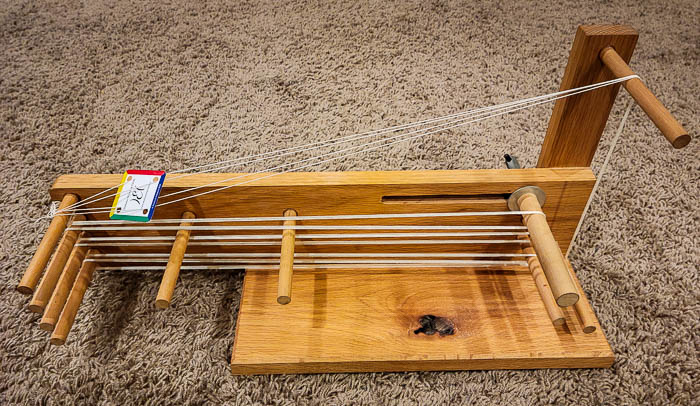
One card down, lots of cards to go. As you can see, there are four threads passing through it, one per hole; you may also have noticed the edges of the card are color-coded. That’s because most of these will not have all four threads be identical, and once the cards start rotating, you need a way to keep track of which threads have gone where. Traditionally the holes are lettered A, B, C, D — which these lack — but it’s easier to see what you’ve got if you mark the edges; the ones I inherited from a friend (which do have the letters) had a highlighter run over them for that purpose.

I wasn’t paying close enough attention when I bought the new ones; they are tiny compared to the ones I got from my friend. I have no idea if I’ll wind up regretting that: they’ll probably be easier to turn (especially since they’re laminated), but the shed they create is much smaller. We’ll see.

That’s four cards warped, with the second color now showing up. We’re on our way!
Since I complained above about the inkle-weaving habits that don’t apply here, I should note one that does: I remembered, while waiting for the tablets, that it’s good to check the loom from the side before you finish tying off a thread, to make sure you didn’t accidentally pass over a peg you should have gone under or otherwise screw up the placement. For this enterprise to work, all the warp threads need to be the same length, running along the same path. I already caught one place I’d almost messed up, so that precaution is worth the effort.
My next update will come when I start weaving. How long will the rest of the warping take? Who knows! I am out of practice at this stuff; I will have to be much more meticulous to make sure I put the right colors in the right places and also in the right threading direction (because on some cards it will run front-to-back instead of back-to-front)*; and also I’m not young anymore, but warping is still most easily done on the floor, which my back starts to dislike after a while.
*Yyyyyeah, so, I warped two more tablets after scheduling this post and then figured out that I had a flaw in my draft, the fixing of which requires me to thread tablets 4-6 down instead of up. HOWEVER! Before I resigned myself to either cutting twelve threads off the loom or painstakingly untying them and redoing them no matter which method I chose, I realized that I could solve this problem with trivial ease by just flipping the cards around and rotating them a quarter-turn to put the single white thread each one of them contains back where it needs to be. If I were doing anything more complex than the pattern I have in mind, this would be a nightmare, because it messes up that color-coding thing: a quarter turn that will put the red on top for the cards with the correct facing will instead put the green on top for these. But since my plan involves rotating the whole deck together the entire time, with no fancy variations along the way, I can actually survive this. And it’s less annoying than redoing that whole bit.

Pictured: not a good idea. But I can make it work.
Anyway, we’ll find out as we go just how wide of a pattern I can actually warp onto here. The threads all have to stay on the pegs; it’s no good if they start slipping off because they’re too crowded. I can (and probably will) put rubber bands or, better yet, hair elastics on the ends of the pegs to protect against slippage, but still, there’s a limit to how wide a band I can weave. I think I’ll be okay, since I only want my final product to be about an inch wide, but the knots at the front add a lot of local width. I’ll just have to play it by ear.
Yes, the New Worlds Patreon is quoting The Princess Bride this week. (This is very on-brand for me.) We’re talking about siege warfare — comment over there!
