Sign up for my newsletter to receive news and updates!

Posts Tagged ‘the dwj project’

The DWJ Project: The Ogre Downstairs

Caspar, Johnny, and Gwinny are none too happy with their mother having remarried, to a man they think of as the Ogre. The Ogre’s sons, Douglas and Malcolm, aren’t very happy with it either. Then the Ogre buys Johnny and Malcolm chemistry sets, and wacky hijinks ensue when some of the chemicals turn out to be magic.

This, like Witch’s Business (aka Wilkins’ Tooth), is in the camp of “books I read once and never went back to.” It’s not hard to see why. This isn’t a bad novel; it may bear a strong resemblance to the stories in Stopping for a Spell, but it’s far better than any of those, probably because it’s longer and therefore has more time to develop its ideas. But there’s no deeper, more fantastical layer — not even the hint of one you get in Witch’s Business. The chemicals that drive the plot never get explained, and their source vanishes at the end of the book, without ever having made more than a cameo appearance in the tale. So basically, this feels more like standard-issue children’s fantasy, less like Diana Wynne Jones.

There are a few characteristic touches, though, discussion of which I’ll put behind the cut.

(more…)

The DWJ Project: Witch’s Business

Originally published as Wilkins’ Tooth. I don’t know why the title got changed, unless it was because some marketing person thought the original might be mistaken for a mundane story about Wilkins going to the dentist.

This was Diana Wynne Jones’ first fantasy novel for children (her second novel at all, after Changeover, which I can’t find for less than eighty dollars and may never end up reading.) In it, a pair of children whose pocket-money has been stopped set up a revenge business — Own Back, Ltd. — but run into trouble when the local crackpot turns out to be a witch who feels they’re intruding on her territory.

The premise feels pretty standard for a children’s book, whether fantastical or otherwise — much moreso than her later novels do. The protagonists sort of hope somebody will hire them to get revenge on the local bully, but instead the bully hires/blackmails them to get revenge on his behalf. Their efforts to carry out the job lead to more trouble, things snowball, the kids hit a point where they owe too much to too many people, etc. It’s pleasant reading, but not memorable; I’m not surprised that I’ve never gone back to re-read this one.

The one almost-memorable part has to do with the witch and the Adams family (not to be confused with the Addams family). Another author might have stayed with the simple plot of escalating problems, but DWJ hints at a deeper layer that created many of those problems in the first place. Unfortunately, she only hints: we never get much detail about why the Adamses were cursed, etc. I wish there had been more of that, to underpin the fun with something a little more substantial. But I’ll have more thoughts about that when I report back on The Ogre Downstairs.

The DWJ Project: Dogsbody

Tackled this one at the request of marumae. (Or rather, moved it up in the queue at her request.)

Quick synopsis: Sirius is a luminary, a member of a godlike race of entities that inhabit and personify the stars of the universe. At the beginning of the book, he’s put on trial for having killed another luminary using a Zoi, which is an object of great power. But instead of being executed for his crime, he’s exiled to Earth, in the body of a dog. If he can find and recover the Zoi before the dog’s natural lifespan ends, he can return home.

It is, as marumae said, a very bittersweet book. Sirius, born as a helpless puppy, takes a while to understand what’s going on around him, but we the readers can see the unpleasantness of it from the start. There are a lot of of awful people in this book (as well as some very good ones), and the worst part is that they’re completely plausible in their awfulness: not mustache-twirling villains, but people with ordinary cruelty and lack of compassion. And then there’s a second, subtler kind of unpleasantness, which is the inhuman nature of luminaries; they aren’t necessarily bad, but even at their best they don’t have human considerations.

The interesting thing for me, reading this book, is that I now have the perspective to see how this feels like a Diana Wynne Jones who hasn’t fully hit her stride. (Dogsbody was published in 1975; it was her fifth book, and fourth work of fantasy.) All her usual touches are here: finely observed detail, souls both generous and stingy, abused children, numinous wonder breaking through into the ordinary, and more. But there’s a lot at the end, after Sirius and the others follow the cold hounds, that is fabulous in concept but (for me) not quite there in execution. Explaining why involves spoilers, so stay outside the cut if you want to avoid the next two paragraphs.

(more…)

The DWJ Project: Stopping for a Spell

I decided to spread the short-fiction collections out between novels, and tackled this one first.

All three of the stories contained in it were originally published independently; Fantastic Fiction lists Chair Person and Four Grannies as novels, and Who Got Rid of Angus Flint? as a picture book. All three come with illustrations in this collection, though, and they’re all about the same length, so I wouldn’t be surprised if the first two were picture books, too.

I know I’ve read some, maybe all, of her shorter work before, but I can’t say any of it ever really made an impression on me. Coming at it now, I have to say the impression made by these three stories isn’t very good. The magic in all three is thoroughly arbitrary, working for no particular reason and then stopping when it’s no longer needed. “Chair Person” and “Who Got Rid of Angus Flint?” also share a structure I don’t like very much, namely: “Horrible person moves in and is thoroughly abusive to a family; parents are too polite to get rid of him no matter how bad his actions are; the kids eventually solve the problem with magic.” It’s like the Goon from Archer’s Goon, but without a broader story to dilute the nastiness, and both the Chair Person and Angus Flint are far, far more unpleasant than he is. And I can’t say I was terribly fond of Erg in “Four Grannies,” either, for all that he was nominally the protagonist.

So yeah, not the best. I’ll be interested to see how the rest of her short fiction compares; some people just have a knack for one length over another, and I suspect that may be the case here. So if you’re looking for Diana Wynne Jones books to try out, this is not a good place to start. Aside from the occasional bit of clever description — one of her trademarks, after all — these stories really don’t showcase her strengths.

The DWJ Project: The Homeward Bounders

We’re almost at the end of the Diana Wynne Jones books I wrote recommendations for; this is the last but one. (The final title is Eight Days of Luke, which is also a favorite, but it’s sort of a first-and-a-halfth tier favorite, along with Archer’s Goon and The Power of Three and maybe some others, too.)

So that link has the plot summary and so on. Here, outside the spoiler cut, I’ll say that the only DWJ novel that has ever seemed to me at all similar to this one (and vice versa) is Fire and Hemlock, though I’ve heard people talk about a few others in a way that makes me think I may change that evaluation, once I remind myself of what those others are like. Partly it’s the role of real-world folklore — though in this case the components are easy to spot, since many of them are named in the opening paragraph. The Wandering Jew. The Flying Dutchman (whose ship is on the cover of my edition). Him, whom I won’t name here because this is the non-spoiler part of the discussion, but those of you who have read the book know who I’m talking about. Then again, there may well be other layers that aren’t so obvious to spot.

But really, what makes this one feel akin to Fire and Hemlock is the way it sort of slantwise approaches some really thorny things before turning to look at them directly, without flinching. Neither of these books is precisely happy. They both end on a note of hope, but it’s tempered with some real sorrow, the victory coming at a fair bit of cost. I’m really sort of startled this counts as a kids’ book, even if the protagonist is twelve. But kids need stories of this kind too, I suppose — even if it leaves me, at the age of thirty, feeling like somebody has stomped on my heart.

I think that’s all I can say that’s non-spoilery. Follow me behind the cut for the rest.

(more…)

The DWJ Project: Howl’s Moving Castle

When I started these posts, I had to decide on an icon. I can no longer remember what cover was on the copy of The Lives of Christopher Chant I read back in the day, and sadly, my memory of my original Fire and Hemlock cover turned out to be way cooler than the reality. (In my head, it looked a lot more like the photograph is described. I would pay so much money to see Diana’s actual Fire and Hemlock picture.)

But I remember the cover under which I first read Howl’s Moving Castle. It’s the one you see in this icon, and while Howl himself doesn’t look right, that is Calcifer. (One of the many reasons I was disappointed with Miyazaki’s film is that Calcifer, while adorable, was utterly wrong.) So, since I wanted an icon that might actually be recognized as Diana Wynne Jones-related, this was the natural choice.

Since I’ve started to begin this project by re-reading my first tier of favorites — I don’t have a favorite, one that stands out above all others — I will once again point you at the recommendation I wrote some time ago, which gives you a sense of the plot. This one is much more fairy-tale-ish in its flavor, firmly set by the opening paragraph’s proclamations about the misfortune of being born the eldest of three. Its hard edges aren’t as prominent, either, as in the previous two books; there are some unpleasant notion lurking in the whole business with the fire demons, and also in what happens with Mrs. Pentstemmon (not to mention Prince Justin and the Wizard Suliman), but there’s less that makes you squirm and think, um, these people aren’t entirely good, are they? Howl’s faults, while real, are also less sharp-edged.

But it’s a Diana Wynne Jones book, and that means it also has some interesting truths about people’s behavior. I saw somebody’s post talking about how Christopher gets smacked upside the head by Flavian’s outburst in Lives, and so, in a way, does the reader; there’s a similar kind of reversal here with Fanny, as Sophie’s mental image of her (and the reader’s) changes from the beginning to the end of the book. Sophie’s own motivations are for a time unclear to her, and Howl . . . well, let’s just say that I’m wondering if my childhood fondness for this book somehow primed me to like Francis Crawford of Lymond. There are some unexpected similarities between the two.

I’m wandering close to spoiler territory, though, so I’ll put the rest behind the cut.

(more…)

The DWJ Project: Fire and Hemlock

This is the other book that had to be put up at the top of the reading order: The Lives of Christopher Chant because it’s the first one I read, and Fire and Hemlock because it is, as I’ve said before, the book that made me a writer. Since this month is the five-year anniversary of my first novel being published, the time seemed very right to re-visit it.

As with Lives (and a few others to come), I’m going to cheese out a bit on writing up broad commentary and just point you at my recommendation from 2004. This is, as I say there, a “Tam Lin” story (and a “Thomas the Rhymer” one, too); it’s because of this book that I picked up Pamela Dean’s Tam Lin, which in turn became one of the foundational inspirations of the first novel I ever finished writing. But it isn’t a straightforward retelling of either of those stories. It is, instead, its own riff on the idea, with its own twists and solution.

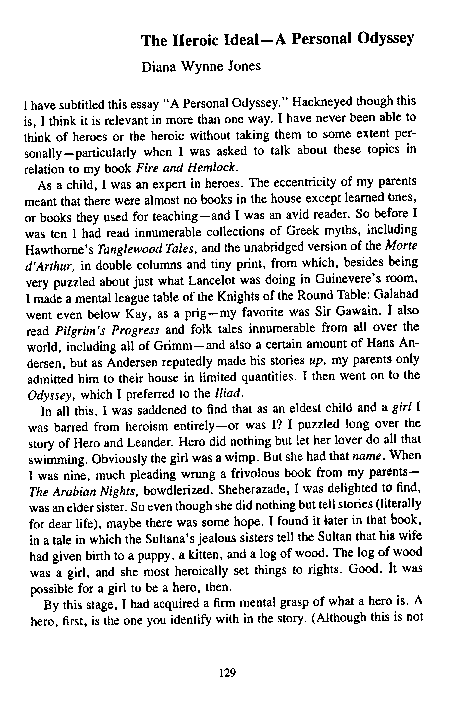
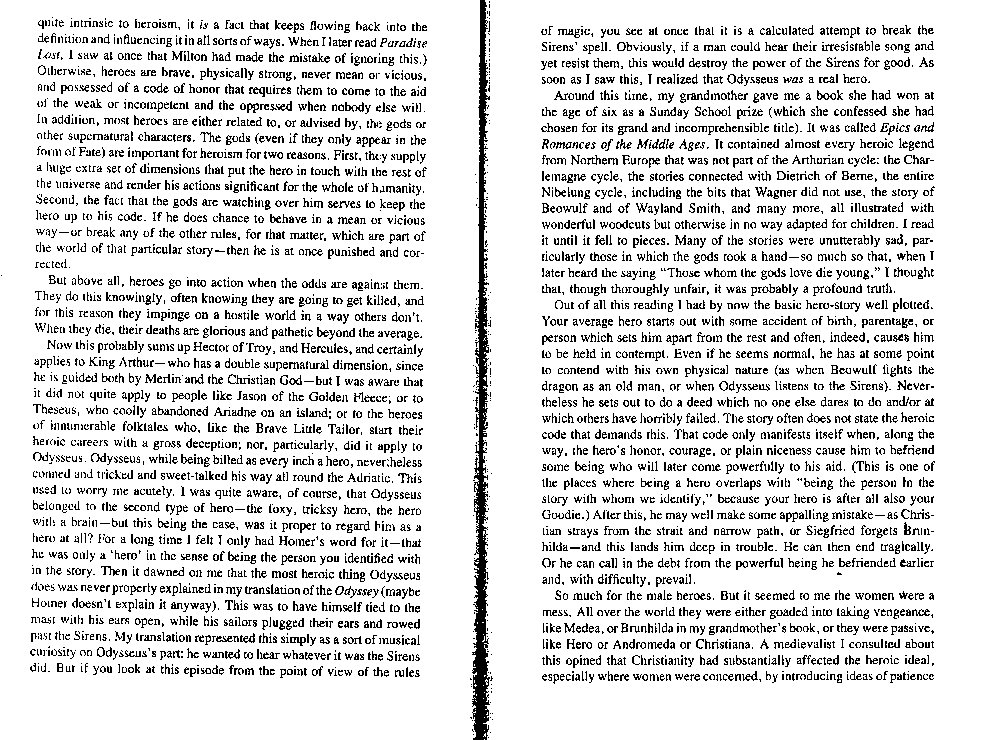
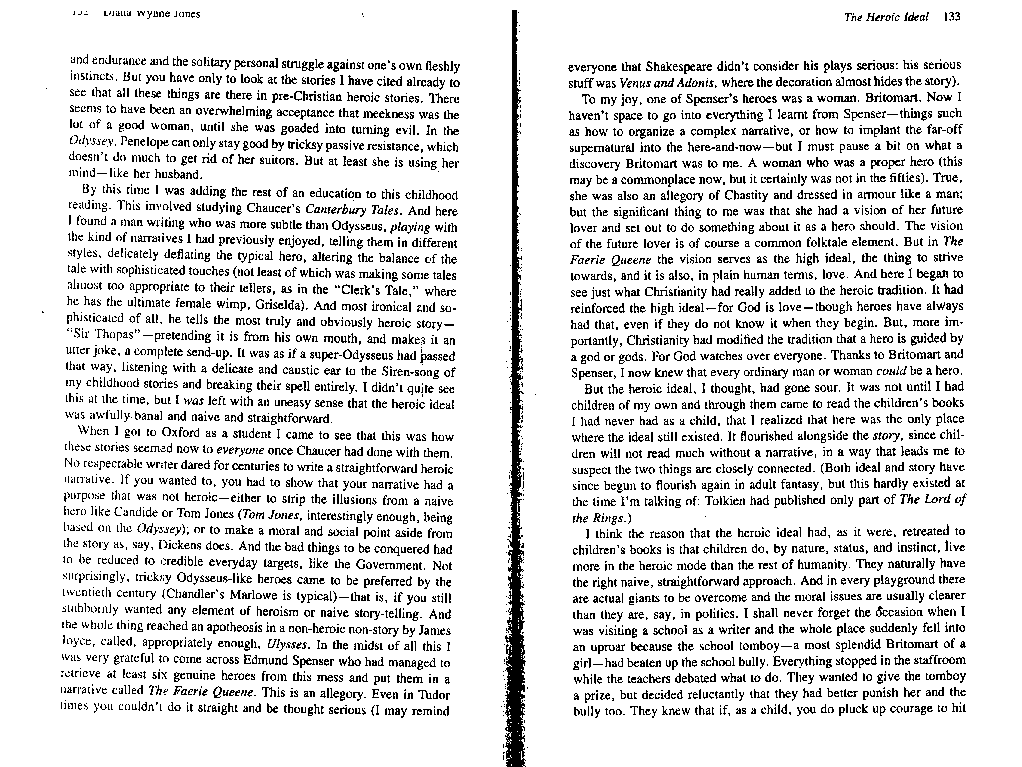
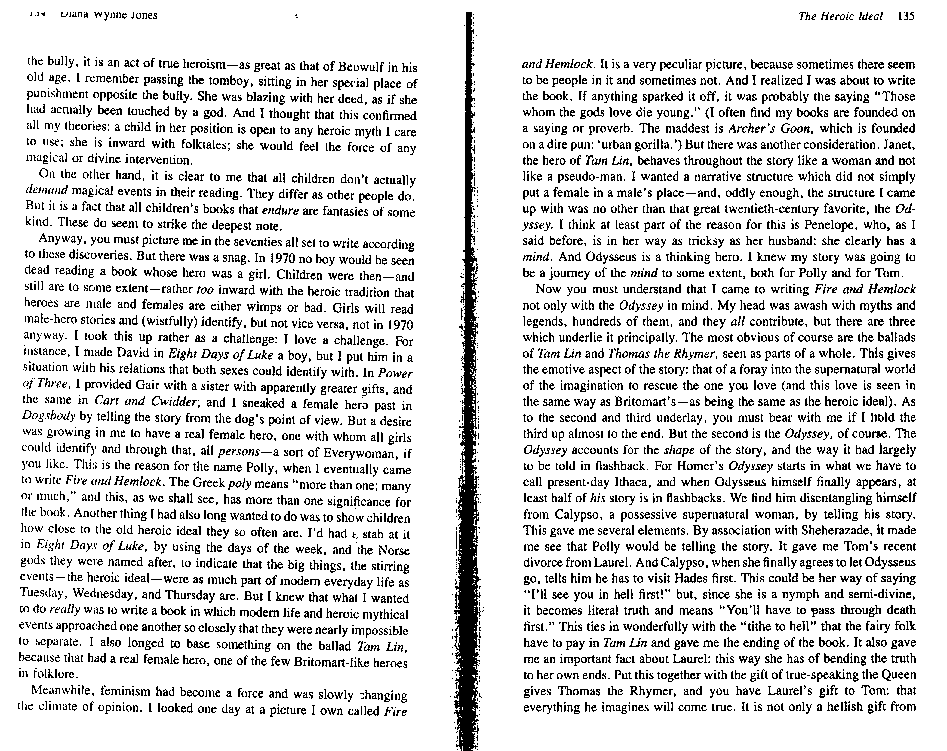
For many years, I would have told you I didn’t understand that solution. In some ways, I still don’t — I mean, I kind of do, but slim as this novel is, I never feel like I can quite hold the entire shape of it in my mind at once. Bits keep slipping through my grasp. This used to bother me a lot, and I blamed it on the fact that I first read the book when I was nine; having gotten a certain form of not-understanding into my head, I couldn’t let go of it and see what was there. Then I read this two-part post by rushthatspeaks, and that referenced an old essay by Diana Wynne Jones that I was able to find online (pages 1, 2, 3, 4, 5, 6, 7), and you know what? I no longer feel the slightest bit ashamed of not being able to comprehend this whole book at once. The layers that went into it boggle me: not just “Tam Lin” and “Thomas the Rhymer,” but the Odyssey, and Cupid and Psyche, and a T.S. Eliot poem I’d never read that turns out to be quite important, not to mention all the trios I’d never consciously thought about, Nina/Polly/Fiona and Granny/Ivy/Polly and Laurel/Polly/Ivy. Re-reading it this time, I bent my brain in half mapping out similar trios among the men. The novel is worlds more complicated than I ever consciously noticed before.

(In case you didn’t guess, you shouldn’t read those essays without having read the book first. Spoilers, and a lot of stuff won’t make sense.)

I never thought of DWJ before as the sort of author who would do that kind of intricate weaving within a narrative (hah, the irony of deploying my usual textile-based narrative metaphors for this). I’ve always known she was an incredibly strong storyteller, but now I find myself wondering if I’ll spot anything as elaborately layered in her other books, or if Fire and Hemlock is going to stand apart from the others in that regard. I know it’s always felt different; only The Homeward Bounders ever seemed comparable to me. But as I go back for this project, I may find it has other cousins among her work.

Okay, behind the cut for more spoilery bits.

(more…)

The DWJ Project: The Lives of Christopher Chant

After much hemming and hawing, I decided that I needed to start the re-read with The Lives of Christopher Chant, as it was — so far as I recall — the first DWJ book I ever read.

So I think what I’m going to do with this project is post an entry for each book, and put the non-spoilery stuff up top, then hide the spoilery stuff behind a cut. (I’ll put in a warning, for those reading this by RSS feed or other methods that might show the whole entry at once.)

Mind you, it’s hard to know what to say. I love this book in that unreserved way you can generally only get by forming your attachment in childhood, when things can bypass your brain and go straight to your heart. The easy thing to do is point you at the recommendation I wrote back when I was doing those on a monthly basis — with two corrections, those being that I spelled Throgmorten’s name wrong there (how could I make such a mistake?) and somewhat mis-spoke on what constitutes the unifying thread of the story. It’s really more about Christopher’s spirit travels than it is about the Chrestomanci business.

If you want an introduction to Diana Wynne Jones’ work, I’d say this is a good place to start. It has a lot of her hallmarks: children with more power than they’re initially aware of, hard bits the story doesn’t flinch away from, choices with consequences. It also sets you up for the rest of the Chrestomanci books, all of which take place later, though half of which (Charmed Life, Witch Week, and the Magicians of Caprona) were written sooner. (When I get to Charmed Life, I’ll have more to say about the chronological relationship of those two.) I really love the concept of the Related Worlds, and the notion behind just how nine-lived enchanters come to exist, and I also love the way the story seems to go beyond the boundaries of the frame. Just how did Cosimo Chant and Miranda Argent end up married, anyway? What happens with Fennig and Oneir after Christopher leaves school? What’s the tragic tale of Mordecai Roberts and Miss Rosalie, before the book begins? We get hints, but nothing extensive, and if you tell me there’s fanfic out there answering those questions, I won’t be at all surprised.

But the stuff I really want to say involves specifics, so let’s go behind the cut for that.

(more…)

The Diana Wynne Jones Project

Okay, folks. So I mentioned a while ago that I think I’m going to re-read the complete works of Diana Wynne Jones.

How should I go about doing this?

She wrote multiple different series, and a whole lot of stand-alone books. Should I read them in chronological order of publication? That would, in some cases, break up series by rather large amounts. Read all the series first, then tackle the stand-alones, in chronological order or not? Go at it any which way, grabbing whatever tickles my fancy? I’m really not sure how best to approach it. The one thing I’m sure of is that I’ll start with either Fire and Hemlock (beause it made me a writer) or The Lives of Christopher Chant (because it was the first one I read), but recommendations for what to do after that would be welcome.

For the first time, it occurs to me to wonder if my subconscious had The Lives of Christopher Chant in mind when it came up with the title for “The Deaths of Christopher Marlowe.”

A Seed of Hemlock

Diana Wynne Jones has passed away.

I deeply regret, as I knew I would, that I didn’t make it to the special Diana Wynne Jones convention in Britain a few years back. It was my one real chance to meet her, and honestly? If I could meet any writer in the world, I probably would have chosen her. Possibly even if “any writer in the world” is expanded to “in history, too,” because Shakespeare’s cool and all, but what would I say to him? His plays may be awesome, but Diana Wynne Jones is the one who made me into a writer.

It was Fire and Hemlock that did it. Polly and Tom telling their story, within the story about them, and the blurring between the two — it’s a story about stories, in many ways, because among other things the book is about “Thomas the Rhymer” and “Tam Lin,” too. I was nine when I read it, and when I put the book down, one thought stood out clearly, for the first time in my life: I want to tell a story.

I did get to tell her that, at least, via the proxy of Sharyn November, when her (I think) seventy-fifth birthday rolled by. Sharyn was collecting birthday messages, so I typed up the tale of how Fire and Hemlock turned the nebulous storytelling impulses so many children have into a firm intention, and lo and behold I am now a writer. But I would have loved to shake her hand, and to thank her for inspiring me to my purpose in life. I don’t think I write anything like her — I don’t think I write anything like most of the authors I really admire — but it all grew out of the little seed of hemlock she planted in my mind.

. . . to heck with the part of me saying, “um, this would be a huge project and I’m not sure you really have the time.” I think I will undertake to re-read her complete works, and to blog about them as I go. It’s the best tribute I can think to give.

That, and to keep on writing.